

Ahead of Torkwase Dyson’s visiting artist lecture on September 15, 2026, read the artist’s own words on the explorations that led to her animation “Tomorrow Was Yesterday,” commissioned for the 59th Carnegie International. This essay was originally published in the book accompanying the exhibition.
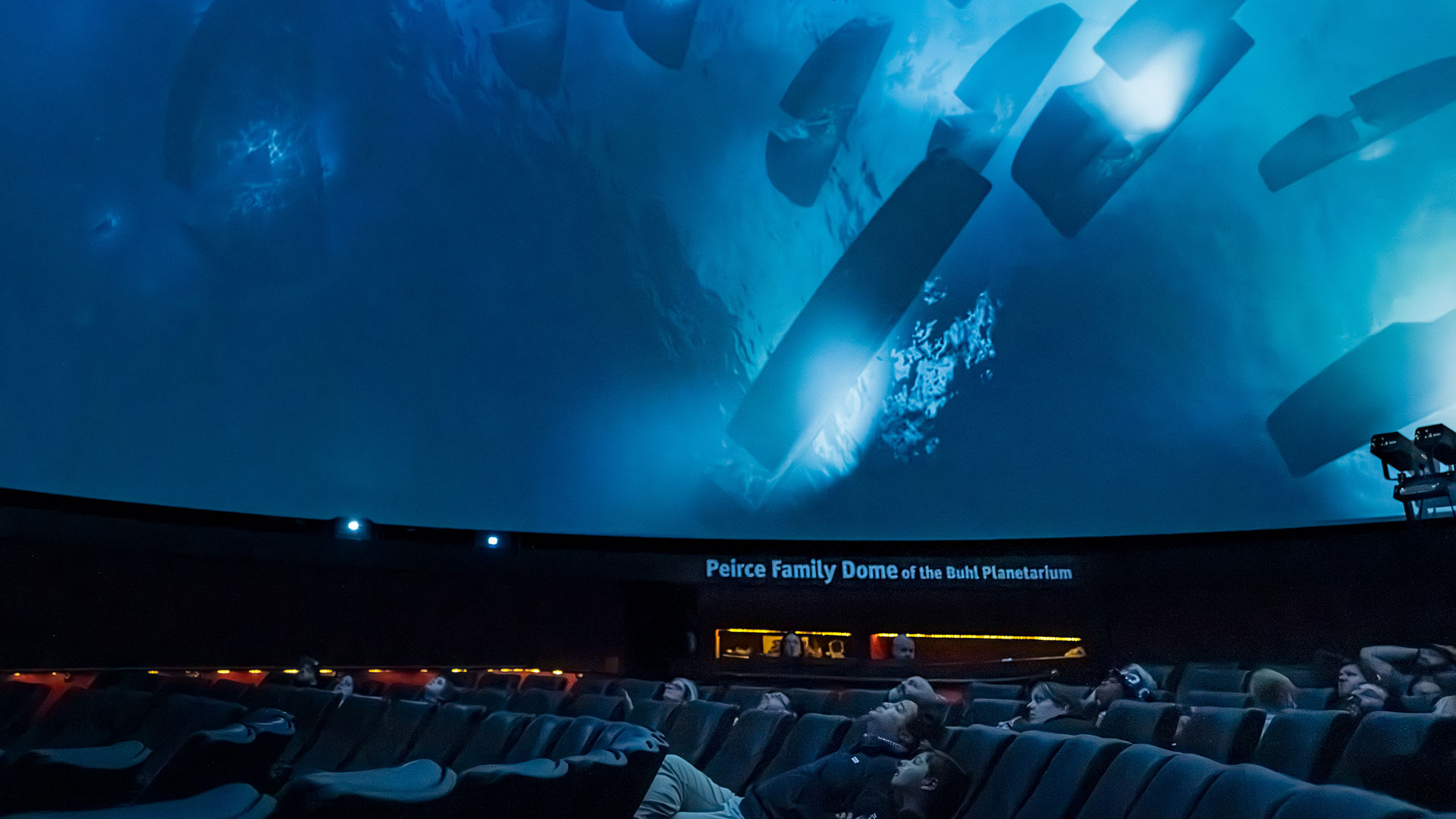
The animation “Tomorrow Was Yesterday” is on view through January 3, 2027, in the Buhl Planetarium at Kamin Science Center. Visitors can also experience the installation — comprised of drawings, paintings, sculptural objects, and a video — that evokes the artist’s studio, on view at Carnegie Museum of Art.
By Torkwase Dyson
For my new commissioned animation, Tomorrow Was Yesterday, I’m drawing to understand gas extraction sites off the coast of Trinidad and Tobago in the Columbus Basin. I’m drawing to compose a space that will be translated into a digital 3-D model and then animated for the planetarium. Drawing becomes a way to ask questions about this site in real time: How fast did bpTT [bp Trinidad and Tobago] develop the crew? Who owns what? What was the exploration process? How fast could they establish extraction? What’s the geological makeup and materials? What is a subsea system? I’m drawing toward the question of speed, infra-structure, and spatial economy. In the animation, the drawing questions my reaction to seeing the mechanics of the extraction site in the middle of a vast, liquid, dark blue ocean.
With drawing, I study different registers of extraction economies; on paper, I can move from geology to architecture, pipelines, and ships. It allows me to move through this world and its layers. As a medium, drawing is inherently in a liminal space of radical indeterminacy. So it allows me to keep up with extraction economies — which are linked directly and profoundly to industrial capitalism — that shift and change over time. It’s a sprawling abstract world under there, and it continues to expand its opaque system. Drawing pushes me beyond the mapping and abstraction of these things. It catapults me into an understanding, a perception, a logic around these economies. Drawing makes things elastic and carries me through a range of real and aesthetic abstractions that are existential. I can think about the spatial and temporal conditions of seabed extraction infrastructures and the scale of their ongoing violence.
Drawing allows me to get deep into the quotidian of my own body, to ask how these extraction economies affect my loved ones. How may it affect my parents? How may it affect my community? How may it affect my memory? My relationship? Drawing makes way for my fear and courage. It also allows me to move beyond the brutal enclosures of capital logics and brings me back to myself, my community, my loved ones, and the places I belong to. Even when I lock myself inside gruesome capitalism, drawing helps me admit to my own madness, and I find my way through/out into new principles of creativity and vulnerability.
I’ve been drawing consistently for over thirty years with whatever medium worked well, but more recently, l’ve been thinking about the relationship between drawing and sound. This possibility opened up conditions for a different kind of mapping of time, scale, distance, speed, and density. For Tomorrow Was Yesterday, sound inspired new questions of proximity, distance, duration, and silence. I’m now composing with wavelengths and graphite, creating a sonic space that helps me connect to things like fault lines, mooring, and my own immersive sonic experiences.

I initially thought about what it would mean to draw sounds — meaning the sounds made when graphite hits the paper when sketching a tanker or a rig — and to make what I call soundings. And these drawings, or soundings, would respond to extraction sites, pumps, ships, oil rigs, architecture, and infrastructure and express the sonic flux of this underwater world. I wanted to consider sound from the perspective of every possible variation down there. At a pump, you hear, maybe every minute, a loud honking sound. I was thinking about the sounds these industrial extraction sites make. Also, when I was working in South Korea in 2023, I was with two other artists — a dancer and a choreographer. We were talking about what it means to be occupied, colonized. We were talking about how colonizers build barriers, walls, fences, and gates to isolate geography, and separate/divide to turn land and humans into property. As a way of thinking beyond those walls and barriers, they spoke of how people send sound across infrastructures and architectures to connect and disrupt the isolation. So, thinking about this relationship and what l’ve learned from collaborators and my experience diving, I understand sound as a part of dispossession in extraction economies, as much as anything else.
And what does it mean to treat sound the way I treat graphite? How do I deal with that when I’m not trained in sound? I thought about layering my soundings on top of field recordings in a multichannel sound system. I discovered I could make an omnidirectional drawing. In that way, sound itself is a material, which, like ink, can be thick or thin and spatialized. With ultra-low bass below 30 Hz, you can feel it more than hear it. I found the physicality to be enormous. For the last few years, l’ve been folding sound into my questions about geography, perceptions, and space. I’m making electronic sound, doing field recordings, and creating sound effects in my studio. In postproduction, I compress, expand, layer, and abstract these sounds. The sound is ephemeral, unstable, multidirectional, and I struggle for perception. It’s the sonic life world of my diving, a sonic knowledge I have from deep listening. Drawing with sound makes me feel like everything I perceive is precarious. Experimenting with sound brought me to ideas of syncopation, a complicated and radical form. In the colonial project of extraction, how do we create disruption? The question is not if we can create disruptions. We can. That’s apparent in the black radical tradition and the traditions of people who refuse, protest, and create revolutions at all scales. The question is: Can we hold the disruption long enough to invent and implement a new world? How far can we deploy the disruption? Extractors know distance! Can we suspend it long enough to replace it? Can we do this without the promise of stability? How agile is syncopation? So, yes, forming sound through the lens of syncopation is critical, metaphysical, and poetic, and it led to notational practice in drawings that is the foundation for improvisation.
Now, when I’m making work to comprehend subsea drilling, wells, pipelines, processing plants, cooling centers, or any extraction geography, drawing and sound take me to a transhistorical mindset. Like drawing, the liminal space of sound is where the invention lives for me. I start responding as a maker to my sensoria, from liquid to solid to mark making to contour drawing, and then the contour lines fall into something that has weight and volume. I can be present in the metamorphosis and a radical indeterminacy. Then the thinking disappears, and the thing in front of me is what l’m ultimately grappling with.
When I’m drawing or making soundings, radical indeterminacy means that I am inviting heat into the practice. My whole being is working at the speed of consciousness, then beyond. When I’m activating drawings, the obstructions and violence in place to abstract extraction worlding disappear. I’m in a non-space, no thinking. Drawing, sound or pen, is an infrastructure in my studio that pushes me into a free fall. The logics of drawing start with the world I am living in as a built environment. When the logics of creativity, the black expanse, improvisation, and syncopation enter in, then you’re beyond the calculations of the snail shell of the world; you are in the disruption and the heat of the incalculable.
Join us on September 15, 2026, at 5:30 pm in Kresge Theatre to hear more from Torkwase Dyson. Full details + registration link here.
This essay originally appeared in the book published on the occasion of If the word we: 59th Carnegie International, curated by Kathe and Jim Patrinos Curators Ryan Inouye, Danielle A. Jackson, and Liz Park, and organized by Carnegie Museum of Art, Pittsburgh, May 2, 2026-January 3, 2027. Copyright © 2026 Carnegie Museum of Art, Carnegie Institute
Image: Installation view of Torkwase Dyson, Tomorrow Was Yesterday (2026) (detail), Kamin Science Center, presenting partner of If the word we, 59th Carnegie International, Carnegie Museum of Art, Pittsburgh; photo: Zachary Riggleman / © Carnegie Museum of Art, Pittsburgh
Video: Produced by Hudson Lines. Courtesy of Carnegie Museum of Art