
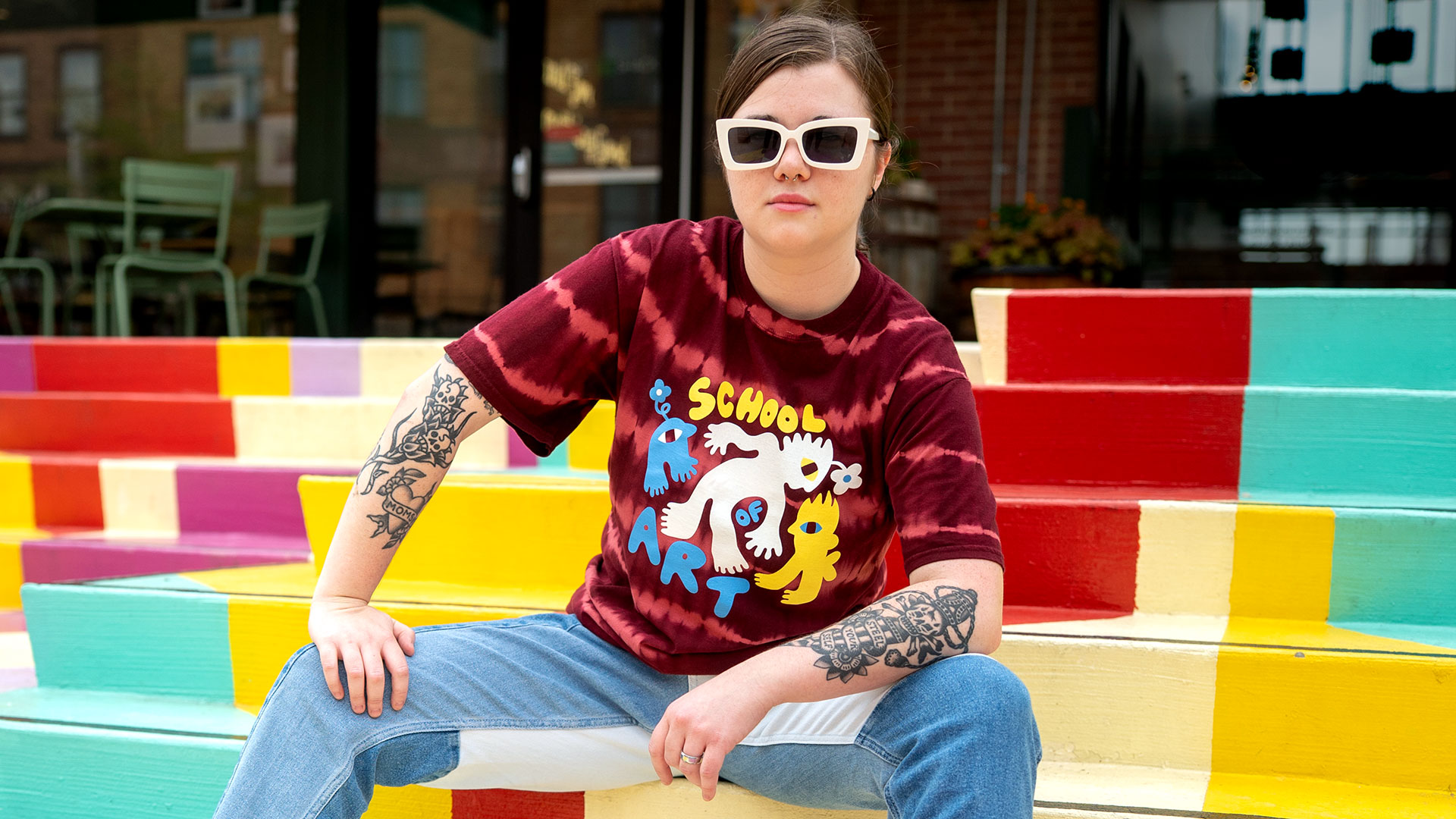
Cartoonist Hannibal Gerald joins the ranks of five previous alumni — Coco Allred (BFA’ 20), Steven Montinar (BFA ’21), Rosabel Rosalind (MFA ’23), Christina Lee (BFA ’14), and Huidi Xiang (MFA ’21) — tapped to celebrate this annual School of Art tradition.
If you look almost anywhere on the streets of Pittsburgh, you’re likely to run into the work of Hannibal Gerald. In addition to her own artistic practice, Gerald designs and fabricates street signs for the city’s Department of Mobility and Infrastructure.
It’s just one of the ways she’s making her mark on the place she’s called home since returning to Carnegie Mellon University as a senior, following a year and a half of remote learning during the pandemic. It was in that interim period as a sophomore and junior that she discovered a passion for comics and zines. “My art did get a lot smaller during that time, and that’s where I started to figure out what I wanted to do,” Gerald says.
Today, she is a member of the National Cartoonists Society and has taken on commissions for independent media like the podcast Swindled and magazine The Baffler. Since 2022, her silly-meets-sharp political comic series CEO Joe has centered around “the CEO of a family business, dedicated to watching others work hard to make him money.” The latest three editions of the series were recently published by Now What?!, a Pittsburgh-based nonprofit production studio using animation and comedy to demystify democracy and encourage civic engagement. Last spring, Gerald also designed the graphic identity for the 2026 Pittsburgh Indie Expo at the Heinz History Center.
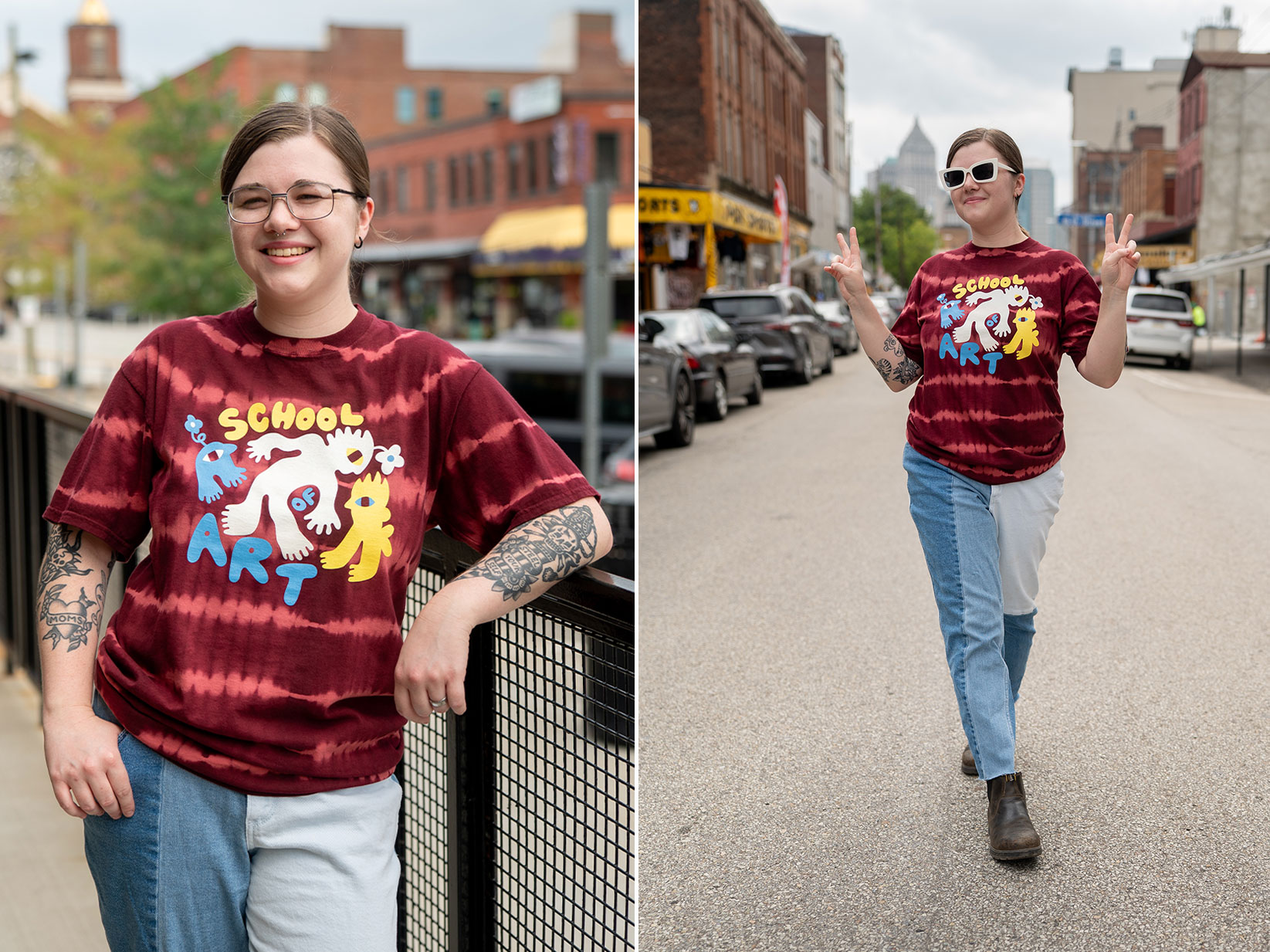
To commemorate the 2026 School of Art T-shirt, we hit the streets in one of Pittsburgh’s most iconic neighborhoods and one Gerald knows well, the Strip District — just blocks from the city’s Sign Shop where she works.
What feels different about when you were first exploring comics versus where you’re at now? And how did that shift lead to your CEO Joe series?
Where I started was a lot more eclectic, working with a zine that was just a collection of mini comics or illustrations. Then I realized I wanted a character that I could do in an ongoing way. I wanted to do something long term, but how my brain worked was I needed to do it in very short slices.
My background as a socialist and my experiences working a sh*tty job after I graduated college led me to develop CEO Joe. I wrote and self-published CEO Joe 1 to 10 and then 11 to 20 in their own zine forms. I started off from my own experience, but it’s definitely become a vehicle for telling a whole host of people’s stories or just generalized experiences that many people have in work environments and with their bosses.
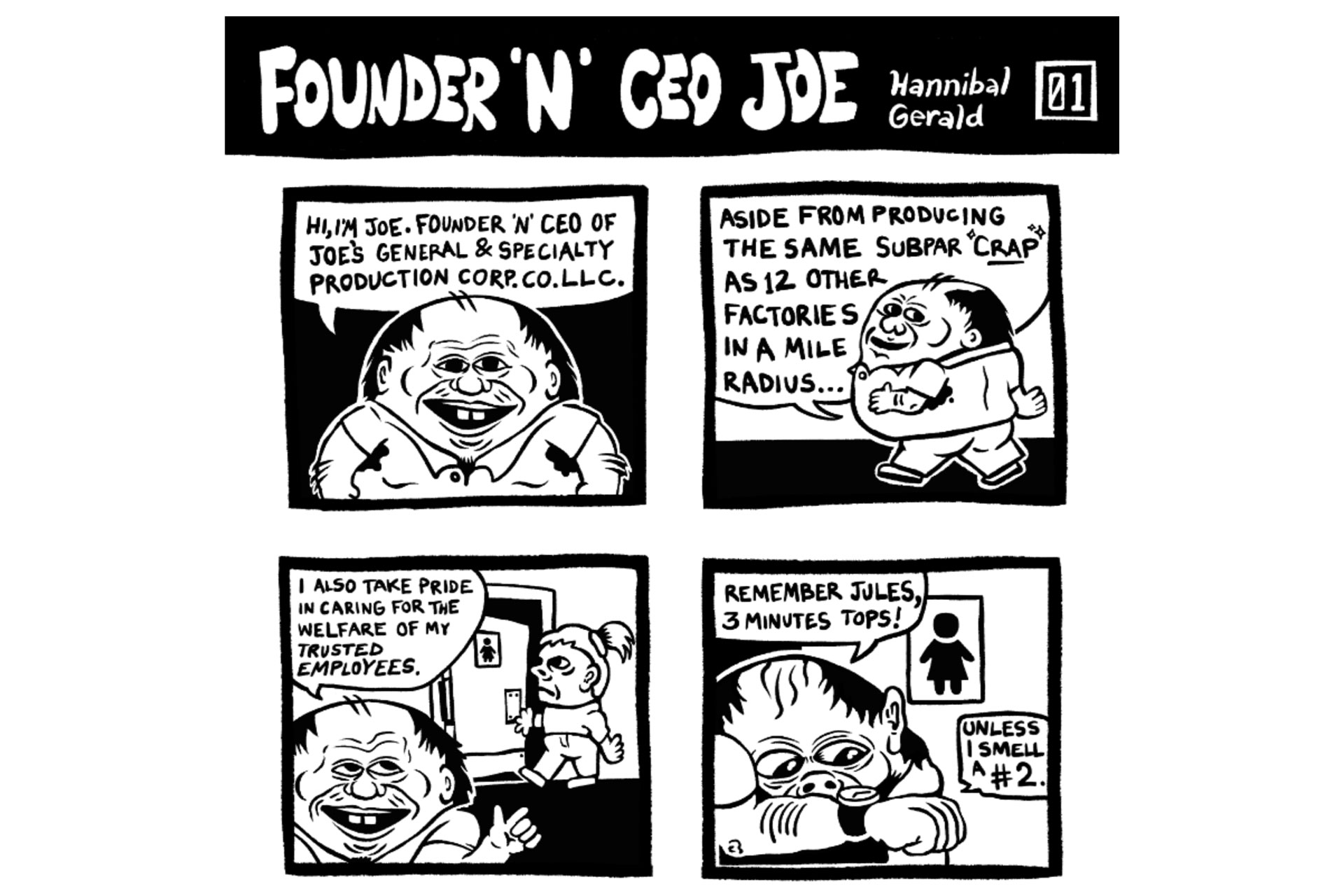
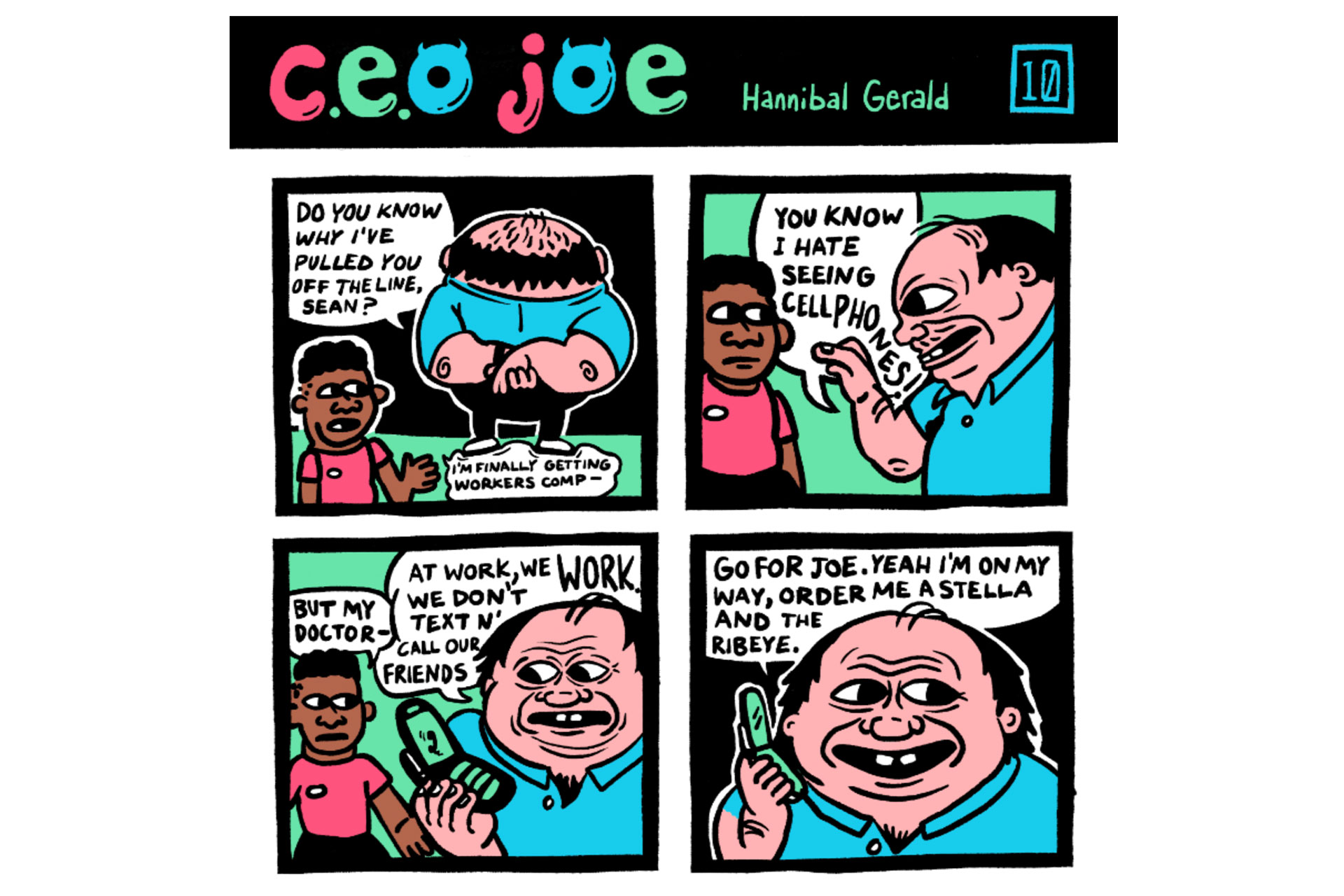
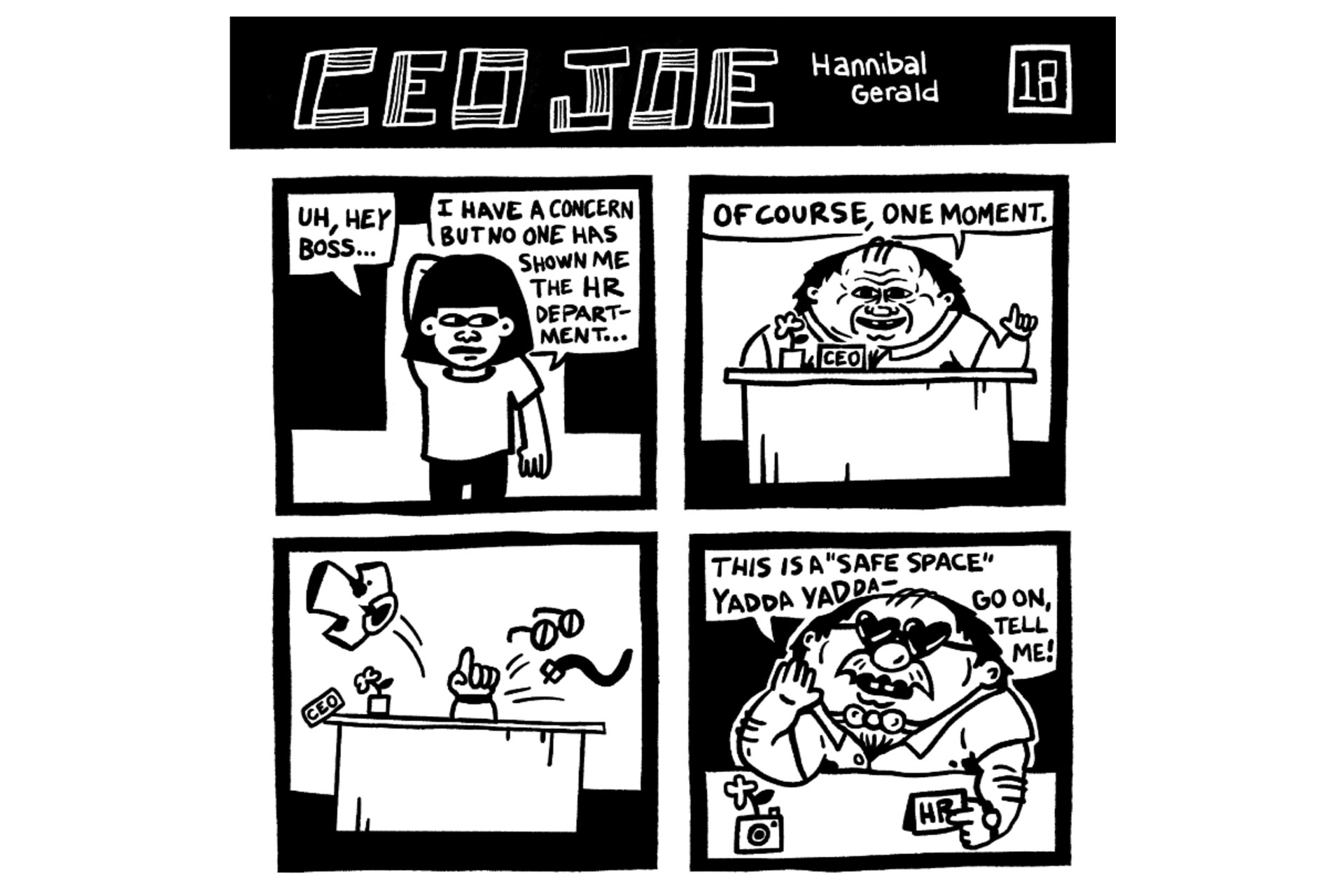
Excerpts from CEO Joe, published 2022-2026
How do you see the relationship between your activism and your artwork?
I’m a member of the organization Socialist Alternative, so I devote a lot of my time to activism: talking to ordinary working-class people, intervening at picket lines and at protests. I think there are a lot of artists out there that believe political art can be a stand-in for real organizing, and I would disagree with that. I think that all kinds of art should be the background music and culture to movements, political expression, and revolution. It has a role, but it is not a substitute for participating and organizing within mass movements and strike action that has the power to halt business as usual and the flow of profits.
Where did you start as you were thinking through concepts for this year’s School of Art t-shirt?
As someone studying art from a young age, one thing that was really important to me — and I still stand by — is learning how to draw the figure, whether it’s very cartoonified or realistic. I was fortunate enough to get to draw from nude models in an after-school program in middle school. I did that on a weekly basis, and I think it really laid the foundation for my artistic ability. Depictions of the human form are pretty common in art that we study and art that we produce, and for good reason. I wanted to depict that but in a more abstracted form.
Hannibal Gerald
How did you decide to stay in Pittsburgh after graduating?
I really like the city. It just has a unique character, a really rich history, and its geography is so beautiful. Growing up just outside New York City was very high octane for my personality, and it’s a bit easier to find your own little niche in Pittsburgh’s art scene and also make connections because it’s maybe not as overwhelming.
I entered the comics community here through the Pittsburgh Zine Fair, where I started selling my prints, zines, and comics. I think that’s really important for an artist to have a combination of an online presence and in-person events. You can have 10,000 followers on Instagram and not actually be getting any work, and you can have 100 followers but actually be quite successful. However, if you have no online presence, those people you meet in person won’t be able to check you out and connect later. So I do think a balance of those is important.
Outside your art practice, you also work for the City of Pittsburgh. What does your day-to-day look like?
I work in the traffic division for the City of Pittsburgh Department of Mobility and Infrastructure. My role is designing and fabricating street and traffic signs. I’m just one of two sign makers responsible for maintaining over 800,000 signs in the city, and there are about a dozen other members on the crew that put them up. Anytime a new street is developed or a sign needs replacing, we’re involved. Sometimes we refurbish and cover old ones when they’re salvaged. Another aspect of our responsibilities is the lettering on the doors in the City-County Building — for the mayor’s office, the city council people, and all of their departments. We also do temporary signage for events the city puts on, like Open Streets and stuff like that.
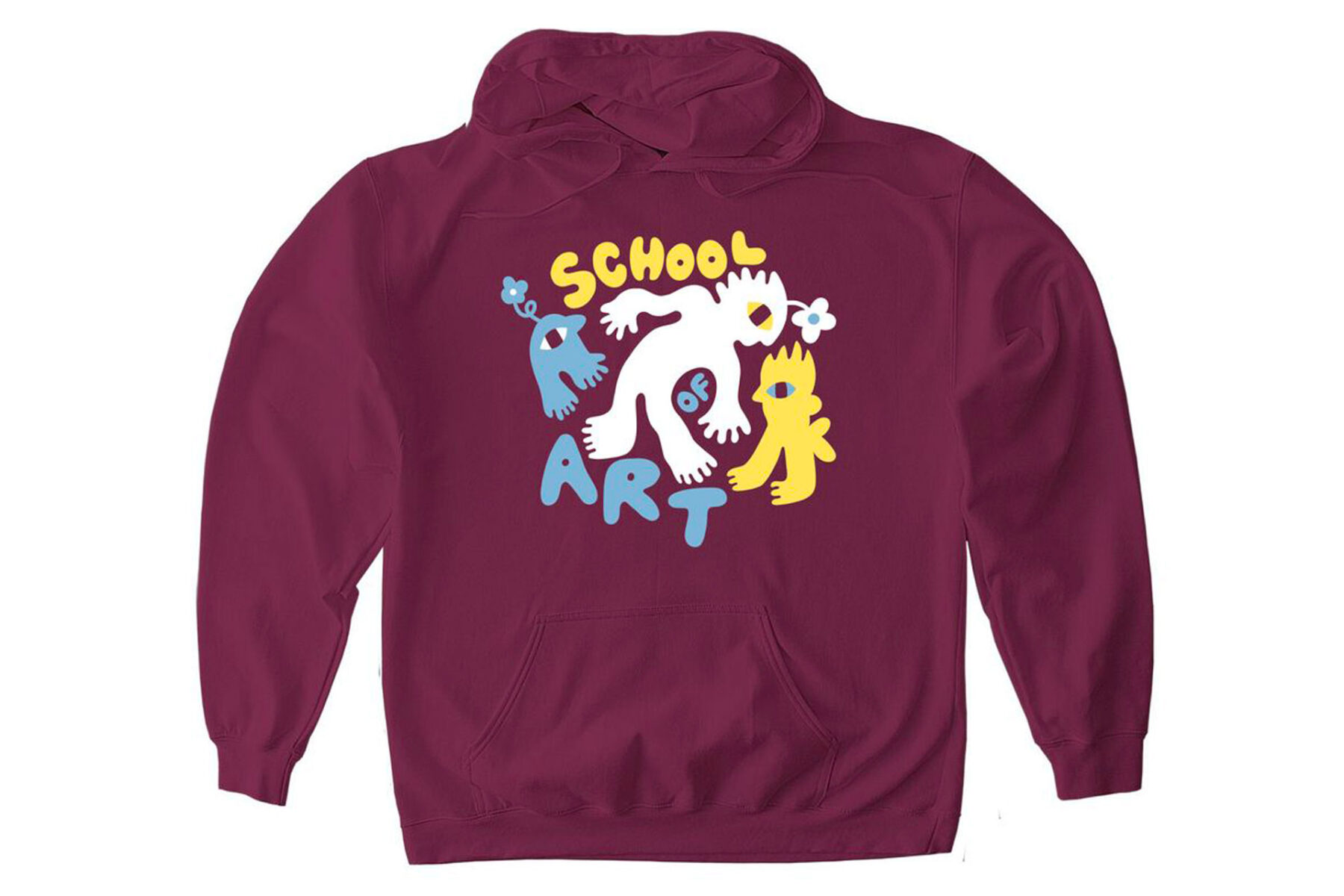
This year’s t-shirt in the School of Art Sweatshirt Collection, available via Bonfire
Can you talk about the name “Hannibal” and how you arrived at using it professionally?
My real name is Hannah. One piece of advice I was given was to be easily found with a Google search, to get a domain name that you don’t have to share with other people. The name Hannah is just so common, especially for the year I was born, so I made kind of an offshoot of my name. I do think women should be able to have men’s names. But it definitely was a bit of a shock when I started publishing and I would go to these in-person things and people would call me “Hannibal.” I did need to get used to having an almost drag persona of being an artist and owning that. So I will say, if you do it, you need to get comfortable with it.
What advice do you have for current students in the School of Art?
One of the things art school provides that you lose after college — and that I sometimes miss — is being around other artists on a regular basis. Value the community you have in art school and being able to collaborate in that environment. It is difficult after college when you’re making work alone and you want to be able to bounce ideas off other people. Meeting at coffee shops to trade zines or do drawings, that’s a really good in-person thing to get yourself to go to as much as you can and get people’s reactions to your work. Part of what I was saying about Pittsburgh before is you can become enmeshed in any artist environment in any city, but it is important to sink roots in one city for a while to actually make and keep long-lasting connections.
More from Hannibal Gerald | hannibalgerald.com | @misterbananawoman