


In this Q&A, Hwang invites us into her grandmother’s garden, a site of care and neglect at the heart of her work — “my work is my messy garden that makes my kind of sense” — and shares what her first solo exhibition, on view November 14–16 at the Frame Gallery, meant to her.
By Amelia De Leon
Bethany Hwang’s first solo exhibition, “Everything Grows Toward You,” is a meditation on memory, decay, and the enduring residue of care. Drawing inspiration from a profoundly personal space about her late grandmother’s family garden in Seoul, Hwang uses the physical reality of a place now suspended between life and planned destruction to explore the subtle, often devastating, line between care and neglect. Since her grandmother’s passing in 2020, the garden has remained untouched, a living memorial waiting in a peculiar tension: “still living, but no longer tended,” she writes in the accompanying wall text.
The exhibition traces how a beloved presence continues to exert a gravitational pull even in absence, shaping the world around it. Hwang’s multidisciplinary approach gathers what can still be held, and what time forgets, articulating the heartbreaking resemblance of neglect to love when the hands that cared are gone. The work is not merely about loss; it is about the direction of life and growth itself, suggesting that everything is still drawn toward the memory, the touch, and the being of the one who nurtured it.
In the Q&A below, Hwang shares more about the origins of this deeply moving series, the meaning behind its title, and what this debut signifies for her artistic journey.

What initially sparked your interest in the boundary between care and neglect?
I am originally from Seoul, South Korea. I don’t get to go home very often, only for winter break and a month for summer, so it’s been interesting to come home after being gone for a while and noticing things immediately. My grandmother’s garden kept getting more dull and unruly each visit. Nobody really took care of it after her passing, I think mostly because it felt so raw for all of us. Then it became out of reverence, trying not to meddle with something she cared for exclusively. So that paradox of caring so much about “preserving” it that we stopped tending was something that I kept going back to. There is such a fine line between love/care and neglect/violence, and digging deeper into that paradox made me walk that tightrope of care and neglect. We’re not trying to neglect it — we’re doing what we think is the best for the garden and to revere it. But at the same time, it’s unkept and untended. There is such an irony behind this, and I could genuinely go on and on. I think that’s why I kept pushing this as a theme in my work.
Walk us through the evolution of the series. What pieces were conceptual turning points or breakthroughs for you?
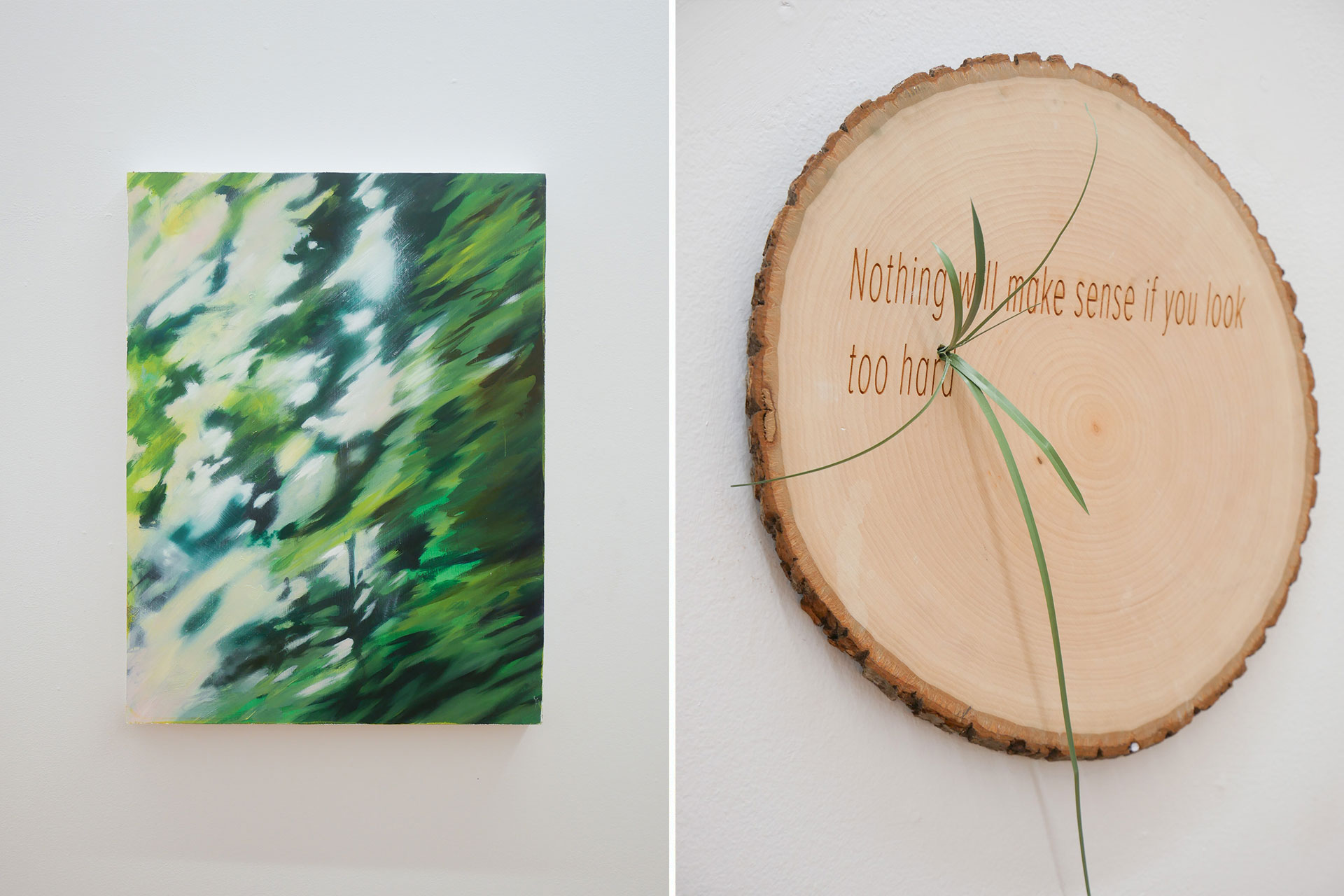
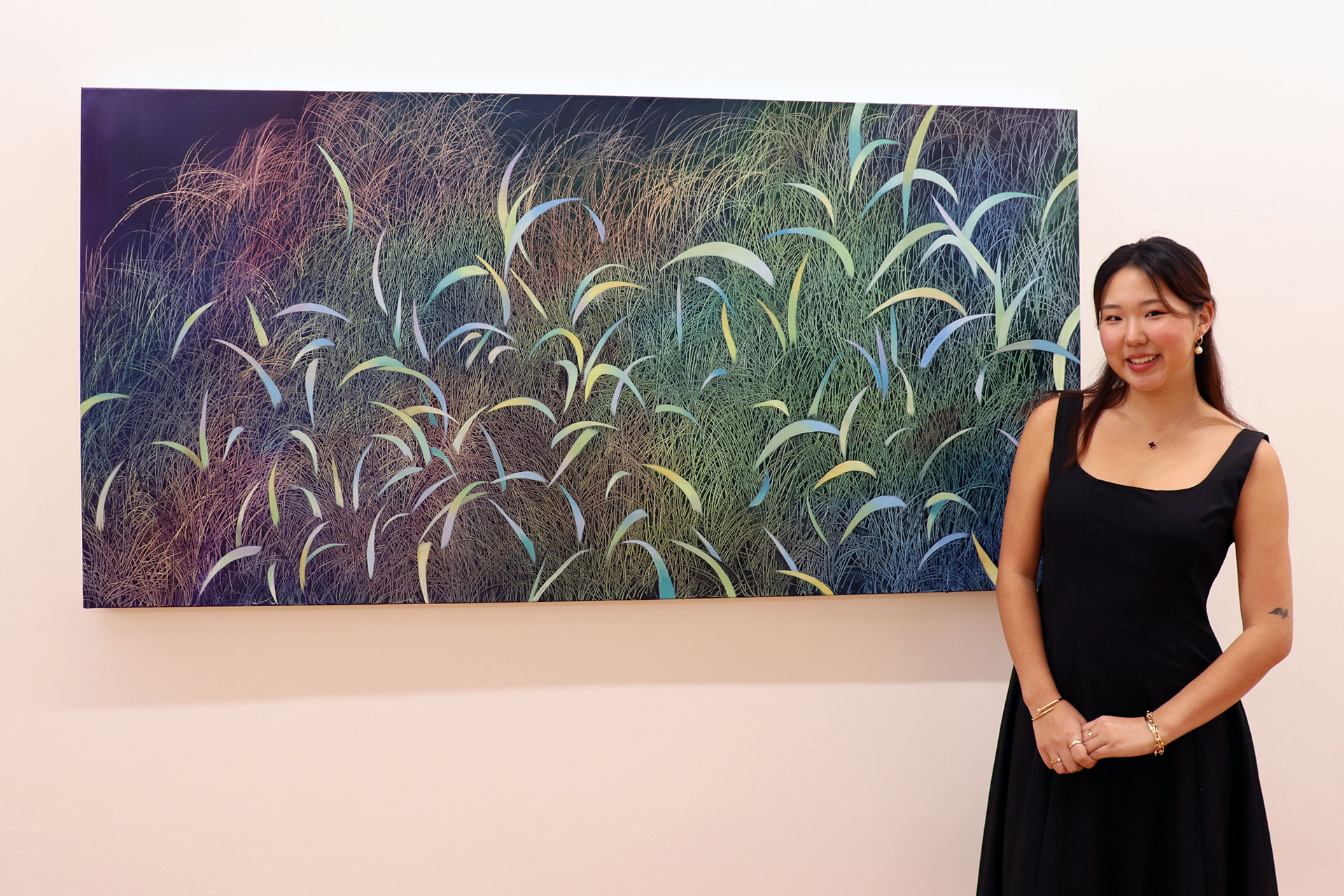
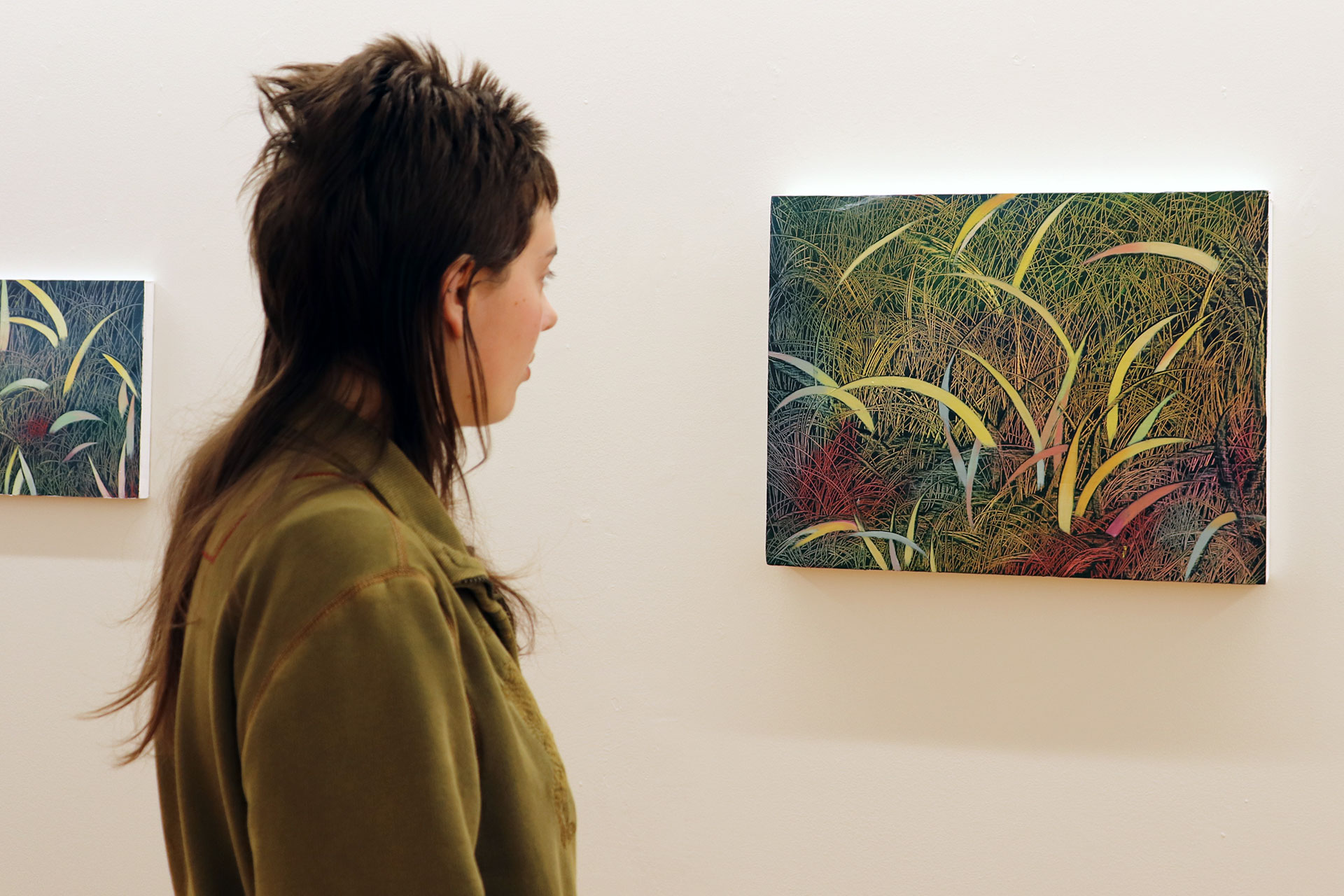
I have been sort of meditating on this garden since the spring of this year. I made a small watercolor diptych in late January, and ever since I have been chipping away at it, bit by bit. All you can really make out of the garden is a lot of grass, and six metasequoia trees my father planted when we moved into our house, each representing a different family member. So those trees and grass have been a consistent motif in my work, I’m just looking at it from a different angle. I used to hand paint all the grass in my paintings, blade by blade. When you’re painting a load of grass every day, essentially you get bored of just adding more green strokes onto the surface. So naturally I started thinking about different ways to approach it: I tried using negative space, and somewhere along the lines I started scraping away to reveal grass instead of painting it. This subtractive process has been super fun for me, especially because it is essentially glorified scratchboard. I love laying down whatever colors and just scraping it, not knowing what the color of the blade is going to be. This is something I love most about being in making mode; just working so much that you’re trying all these different things and landing on something. Right now I’m excited about what this has to offer, and what this could look like in the future. I think this scraped grass is a good starting point, and I’m excited to see what this turns out to be.

How does the title, “Everything Grows Toward You,” evoke the themes you wanted to explore?
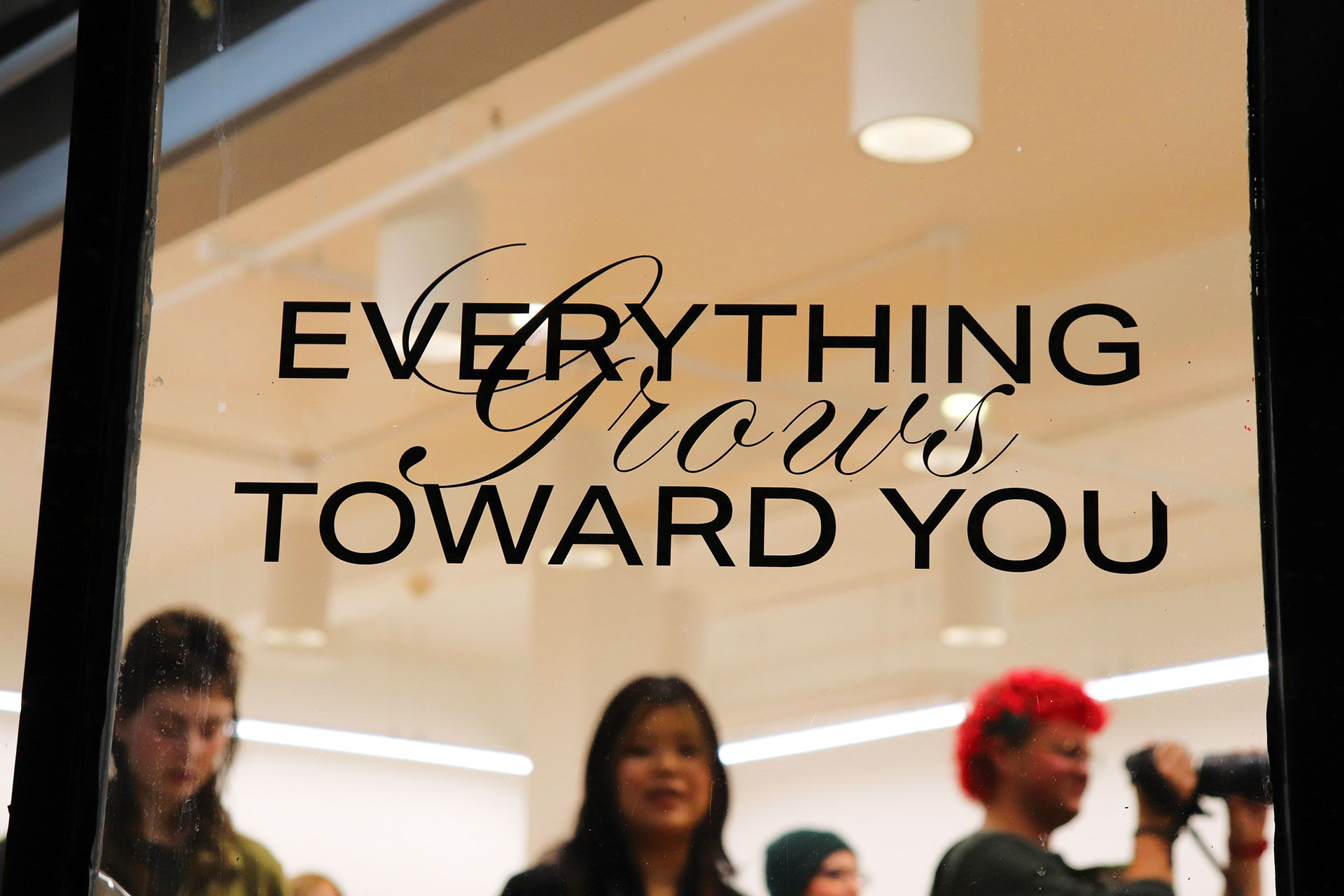
The title was definitely hard to come up with. I had many contenders, but I ultimately decided on “Everything Grows Toward You” because the garden, even in my grandmother’s absence, still bends toward her memory. Her presence, or lack thereof, continues to structure the space and leaves a gravitational pull. The plants still remember her in how they reach toward light, or toward her absence, which has become a Sun of its own kind. Everything that’s presented in the show grows toward this absence in a similar way. I am more focused on this gravitational pull as an orientation rather than a destination. The growth I’m interested in talking about isn’t the botanical kind; it’s the emotional, memorial, and directional sort. This growth becomes a form of reaching toward what shaped me. In trying to reach in that direction, I find myself attempting to move toward the traces of my grandmother’s legacy, to gather what remains, and to make peace with what can no longer be traced.
In the context of your work, do you view care primarily as an action, a state of being, or a psychological space?
I think a mix of all those things — like how I’m thinking about this garden in my work, it moves through all the different stages. Her tending was once real and physical in pruning, watering, touching, and knowing. Her care changed the garden’s shape and trajectory, and that’s not easily changeable. But then the remnants of the garden go through an internal space where longing, responsibility, guilt, and care all coexist. The garden is suspended in this sticky space, where it is preserved out of reverence and neglected out of fear of making edits to what’s left. I’m trying to sit in this tension, where love looks like neglect and neglect mimics devotion. It is the gesture, the echo of the gesture, and the interior world that forms around everything. I enjoy trying to go through this maze and sit in tension.


What feeling or question do you hope viewers leave with?
I hope people walked away feeling soft, warm, and loving! Where I stand with my work right now, I don’t think I’m at a point where I am making a big statement yet. I’m still in reverence mode and I loved sharing what I could trace with the public. My work is mostly for me at the moment, so I enjoyed seeing how it resonated with other people. There is so much love my grandmother showed me in all the ways she approached life, and I tried to treat my work with a similar sense of love. I tend to overcomplicate, overcrowd, overthink, and my work is my messy garden that makes my kind of sense. I would love it if the viewers left with some type of warmth in the heart.
As your first solo show and a culmination of your senior work, what does this exhibition signify for you as an artist moving forward?
I think this exhibition is a good stepping stone for me. There are a lot of things I want to get right next time, just logistically. I love being in a more generative state where I’m cranking out work because I have a real concrete deadline. There are so many things I wish I could have done but couldn’t due to time constraints and all that cliche stuff, but I want to stay in this groove for as long as I can: acting like I have a show in two weeks and continuing to move. I think it just signifies moving forward, whatever that might entail. Keep moving and making work, keep going. Taking rests to pet the grass and whatnot.
More from Bethany Hwang | sebin-hwang.art | @whoisbethanyhwang
Amelia De Leon is a sophomore pursuing a BFA in the School of Art. Follow her at @ameliadeleonn.