



Before Kearra Amaya Gopee’s visiting artist lecture on November 3, 2026, revisit this conversation between Gopee and writer, curator, and scholar Gervais Marsh, originally published in the book accompanying If the word we: 59th Carnegie International.
July 28, 2025
Gervais Marsh: Let’s start with antidisciplinarity in your practice. What does that mean for you?
Kearra Amaya Gopee: When I talk about antidisciplinarity, I mean being against discipline fundamentally — discipline as a medium, as in training, but also in the sense of being disciplined by a force beyond yourself, which could be colonialism or imperialism or whatever -ism you choose. It’s against both discipline and being disciplined.
GM: Much of your approach thinks alongside violence, and particularly the violent logics of anti-Blackness. How does that orient the questions you formulate in your work?
KAG: Well, if we’re thinking about anti-Blackness as the structuring device for the entire world, violence is the first consideration, or at least the impetus for the question. And then naming that violence as anti-Black violence sets the structure for the film, sets the tenor or the pace.
GM: Anti-Blackness as a structure is a constant negotiation, a constant friction. Building on that, can we discuss haunting and intimacy as two conceptual touch points texturing your practice?
KAG: Intimacy more than haunting, because through these projects, I am trying to establish or reinforce existing relationships, depending on whom I’m working with. I mostly work with friends, and this is a way I enter their lives, within certain parameters, to excavate a particular feeling we have between us. I’m haunted or being doggedly chased by a question, which is usually about a particular site of violence.
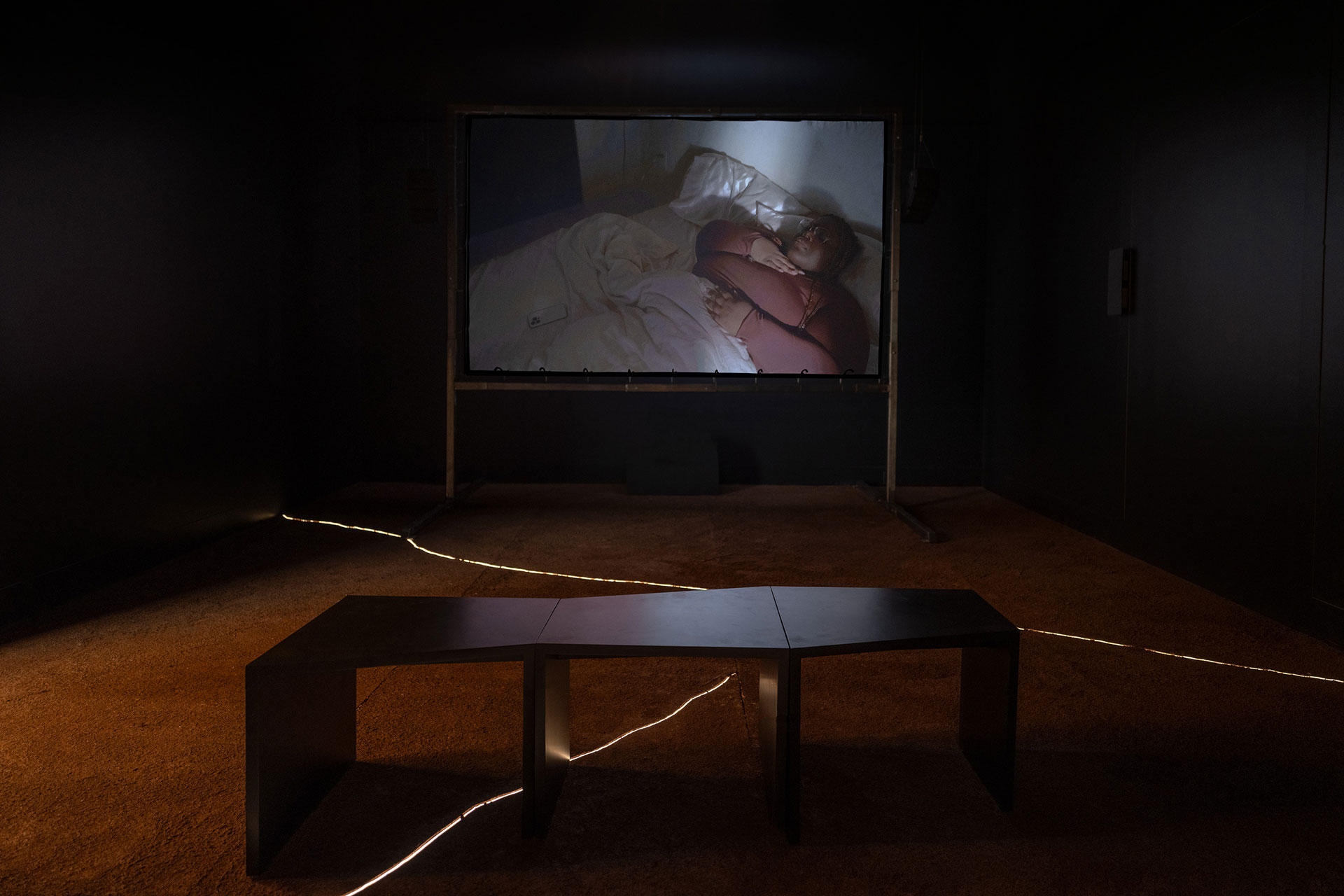
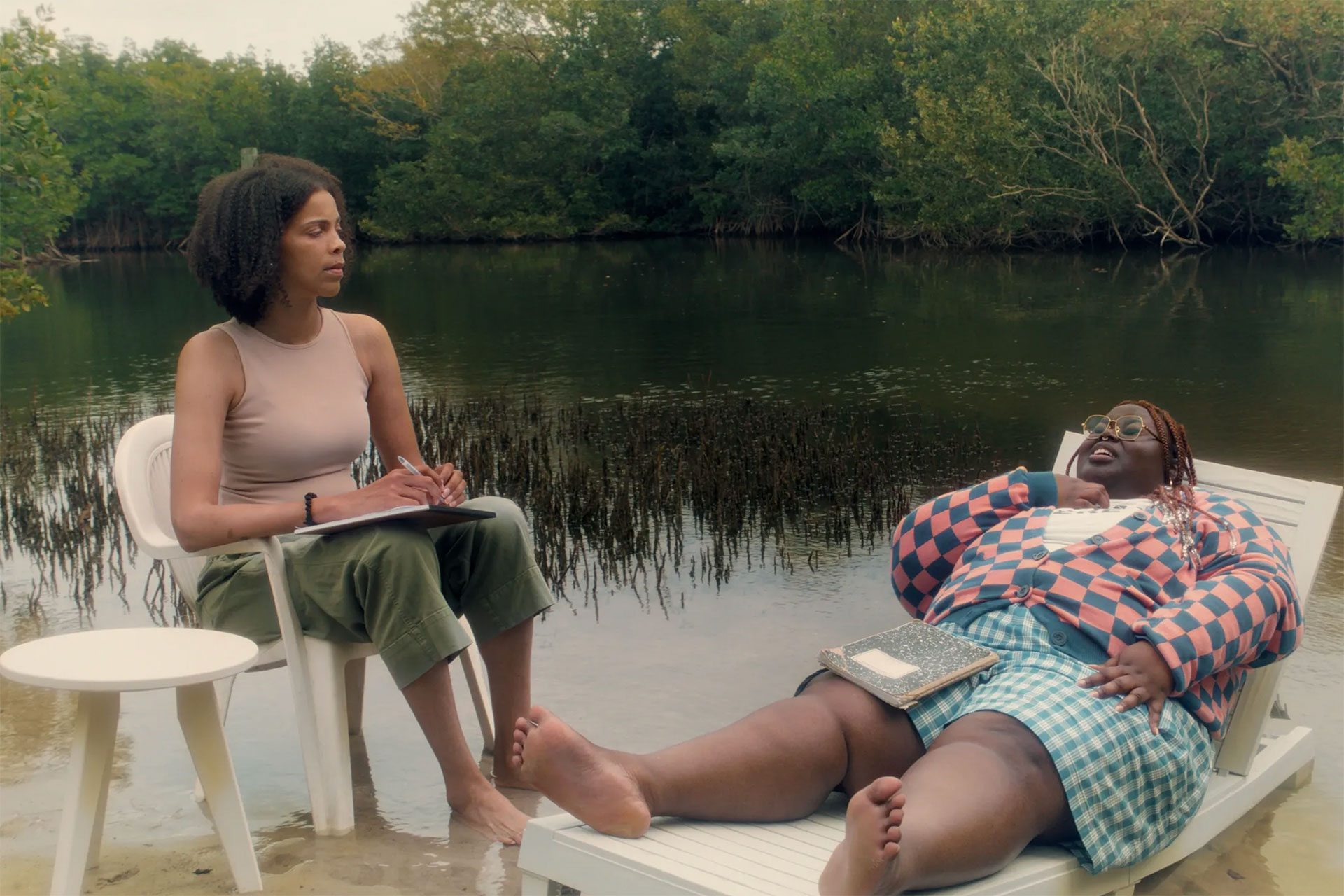
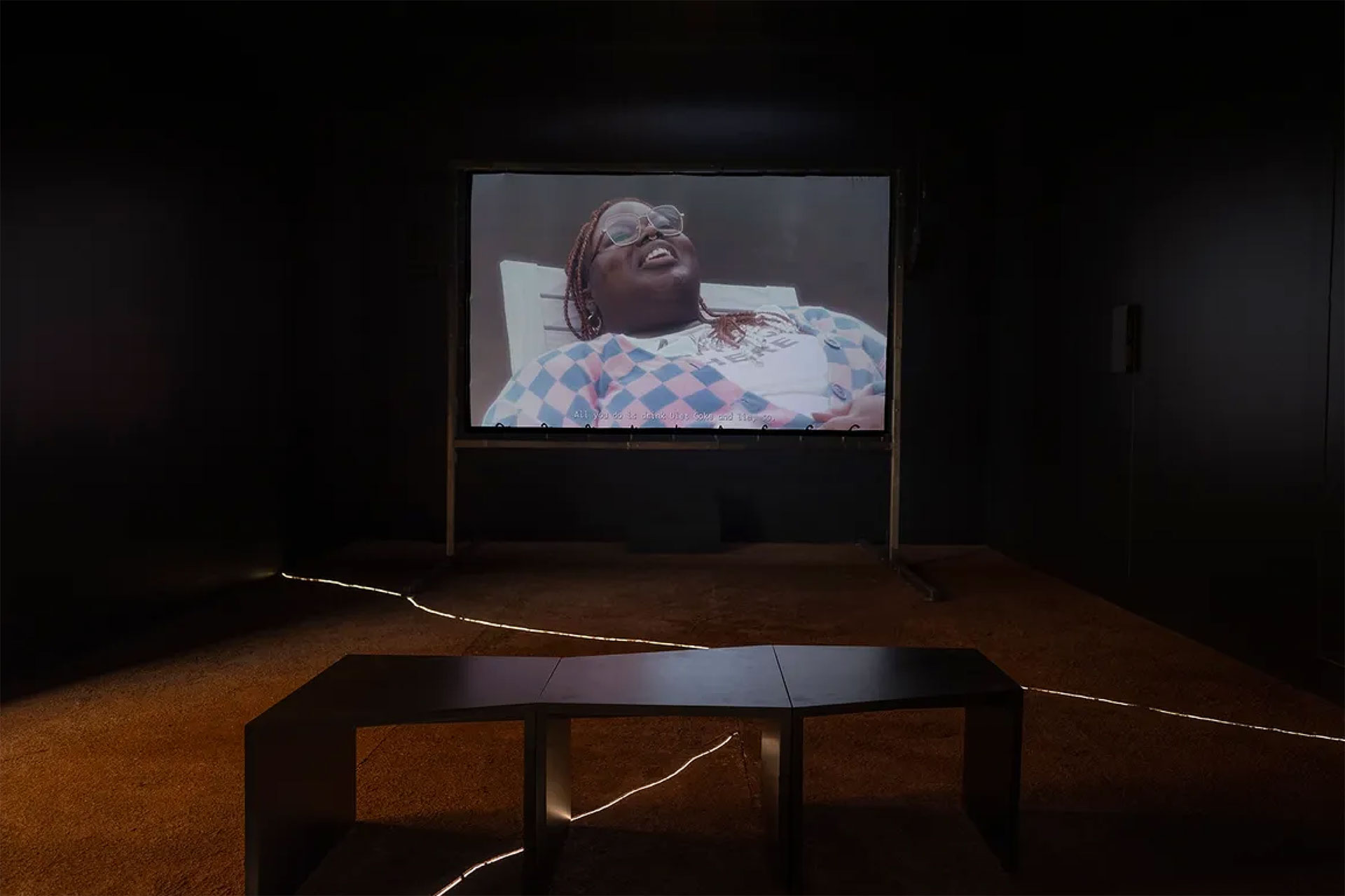
Installation view of Kearra Amaya Gopee, minor demons (2026), in If the word we, 59th Carnegie International, Carnegie Museum of Art, Pittsburgh (May 2, 2026–January 3, 2027); photo: Zachary Riggleman / © Carnegie Museum of Art, Pittsburgh
GM: Does that involve contending with the difficulties that may arise from working with people to whom you are intimately connected?
KAG: The real work for me lives in the process. I will have these kind of abrasive relationships with people I work with, and we negotiate that to get to the end goal of the video. But the actual end goal is a more fleshed-out relationship between me and somebody else.
GM: Your work often grapples with multiple histories existing alongside one another. Why do you feel compelled to tease apart the seams of historiography?
KAG: The way we’re taught to record time is influenced by colonial structures. How we notate time, being, presence, and then absence by default — it’s all coming from a colonial frame, which means that somebody gets left out, somebody disappears. The idea with history is that it’s never really complete. We’re trying to critically fabulate, and sometimes you have to do the work to mend the gaps yourself.
GM: In An Excision Spell (2020), you talk about excising time. What does that make space for, and do you also see an undoing of historiographies through the incision?
KAG: It undoes a kind of normative flow of recording time. The big pillars for me are not just violence but also time as an antagonist — Western time that is engineered solely to manage performance and productivity. My work is slow; it takes forever to make. It pushes back in a very material way against normative scales of production and time, and undoes people’s expectation of time as a disciplining device.
GM: That also releases you from a normative narrative structure. The work in and of itself doesn’t move on a linear, logical path. I see it more as a constellation, in which the critical questions you’re thinking about can reappear at different moments. Do you see potential for reconfiguration in that slippery space between fiction and nonfiction?
KAG: What we consider to be history is fictional for the most part. That’s controversial to say. But everything is coming from a specific viewpoint that is informed by one’s own approach to a place at a particular time. It doesn’t really make sense to talk about the veracity of it.
GM: Throughout several projects, you’ve engaged the potential of revenge as something generative. More recently, you have proposed thinking about spectral notions of justice. Do you feel like revenge and justice are in contradiction, or can they be contemplated together?
KAG: I think they can be thought alongside each other, but it becomes tricky, right? Revenge is a clarifying force. When people are clear about their harm, about the muck they’re in, and clear about who has done it to them, that leads to justice. Revenge is how you get clear, and justice is how you get even. With Pappyshow in the Dark Time, My Love (2022), I’m talking about revenge within a very specific frame-thinking about how people process what they are dealing with because of a kind of colonial backwash, and how they’re reckoning with what is left behind after that. Not necessarily looking for repair, but learning how to settle into the gap between total reconciliation and something you just can’t get a hold of. When it comes to minor demons (2025), a work about my father’s involvement as a member of Trinidad and Tobago’s Flying Squad, I’m thinking about emotional justice in terms of what cannot be accessed on this plane in terms of justice. Some things are totally spiritual to me.
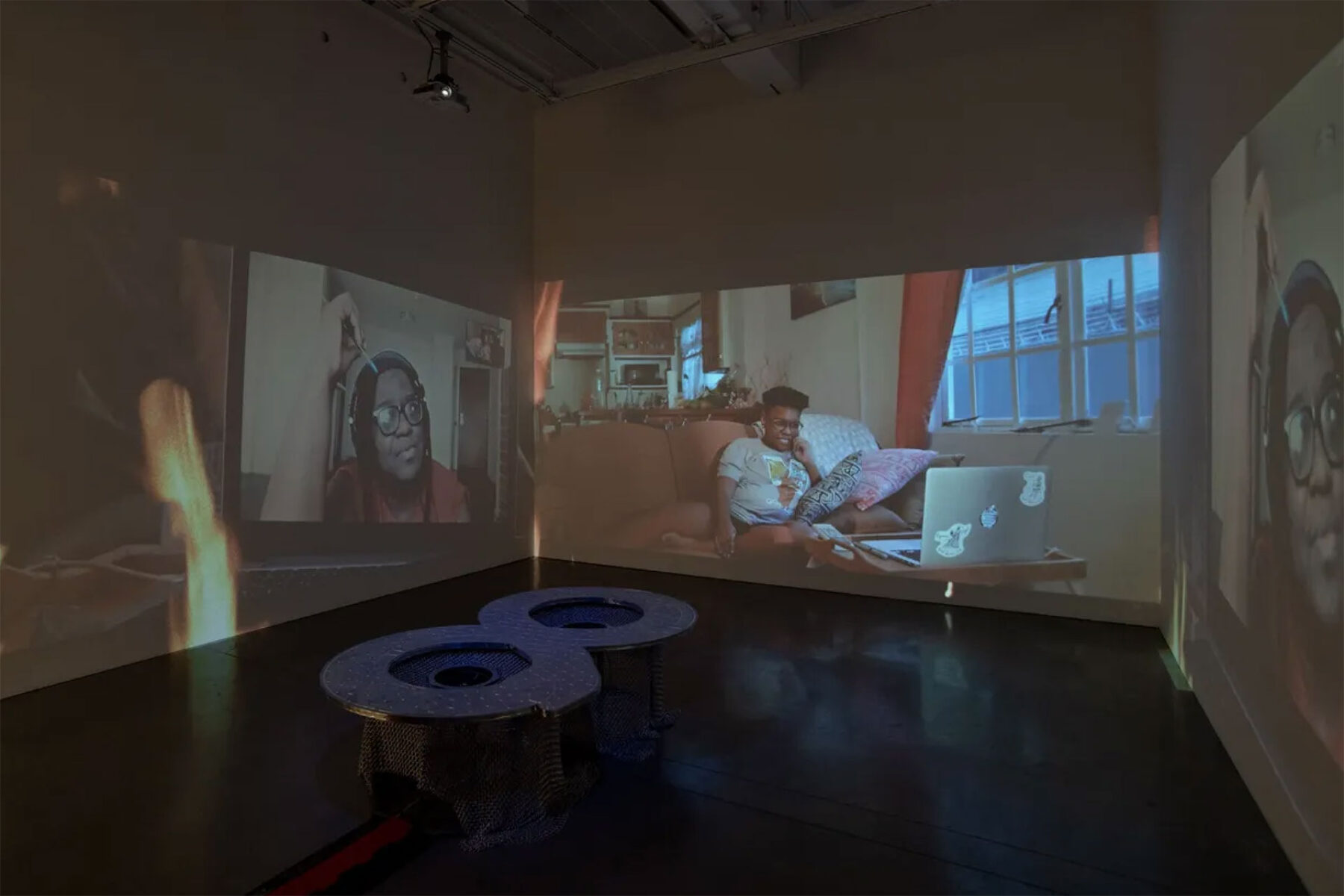
Pappyshow in the Dark Time, My Love (2022). TRT: 25:55, 3-channel projection. Iron, aluminum, chain mail, wood, subwoofers, mixer, amplifier, PA speakers.
GM: But it still exists. It is very much present.
KAG: Very real, but not able to be grasped or held in an easy fashion. The spectral notion of justice is another trick about time. You don’t necessarily get justice in the exact timeline you want. Sometimes your work is to set the ground for somebody else to achieve their notion of justice, or for somebody else to achieve their notion of revenge. Sometimes you don’t get to access that yourself. You don’t get the gratification of exacting suffering or pain or anything like that. It might be that a human lifespan is too short to deal with the work you’re doing, because dealing with something that is coming from four hundred years ago and expecting it to be resolved in one human timeline doesn’t make any sense. So then you’re thinking about spiritual inheritance — of a project, of excavation, of undoing.
GM: Can we get into your thinking about lesbian desire as a nexus for revolution?
KG: Ha ha, no, we can’t do that one yet!
GM: Why is it important for you to name it specifically as lesbian desire?
KAG: It’s important to me because lesbians are made invisible in a particular landscape. Very early on, I was introduced to the writings of Gloria Wekker, thinking about how mati work and other kinds of lesbian interactions with the bedrock of domesticity within particular Caribbean societies.1 Lesbians undo domesticity all the time; we undo what labor is supposed to be by virtue of how we care for each other. It’s a recognition that certain things are not gendered labor but come from a space of total care.
GM: For me, Wekker’s book is also about the messiness of desire in relationships. They’re building homes with each other. They’re supporting each other materially, emotionally. Contending with the messiness of desire opens up a conversation about how desire functions in all these different ways. How do you conceive of queer futurity in a collapsing world?
KAG: I think queerness demands that we collapse the rules sometimes — collapse everything that we understand as normative. I’m thinking about all the ways that queer time is not normative; it is distended, stretched out, and moving through that sort of pulling apart, you find places to escape. When I think about futurity, it’s about sharpening our tools for dealing with how to break things apart. Because we have to break things apart. Futurity is a type of visioning that has to happen. You have to be able to see the collapse clearly, and you have to be able to see the other side of that and be responsive.
GM: Do you think about film as a myth-making medium?
KAG: Yes, it reinforces or crystallizes myth in some instances, depending on how the narrative was written. But with true film, one can develop new vernaculars not only for making and being but also for preserving.
GM: Your work is becoming more explicitly personal, though it’s still a fictionalized version of yourself. How does it feel to become an agent of myth making?
KAG: It’s a very new sensation. I feel a responsibility, because what I’m working through is a history that is not necessarily my own. I don’t want to call it a burden, but it feels very much like I’ve inherited a ghost, and I’m trying to excise that ghost from my being through filmmaking.
GM: Saying that you inherited a ghost makes sense; that’s part of the spiritual inheritance. How do you work through the slipperiness between spiritual and spectral inheritance?
KAG: By reconciling myself to the fact that I’m not going to have all the answers. There are going to be gaps. You have to trust the process to take you as close to sense as possible but also come up with the tools to express the fact that this is beyond sense. We move into the realm of feeling and affect at that point. And that’s where installation comes in for me, because it’s about sensing, touching, feeling, as opposed to knowing inherently and reasoning. Through installation, which involves more tactile materials, one might come to different sensual conclusions than with film alone, because film is still burdened with a history of veracity and truth depending on which tradition you’re working from.
GM: I’m curious about installation as a means to enter that space beyond the burden of proof of the film, moving into that space of affect. How do you think about your own sensuous or sensual relationship to the materials in your installations?
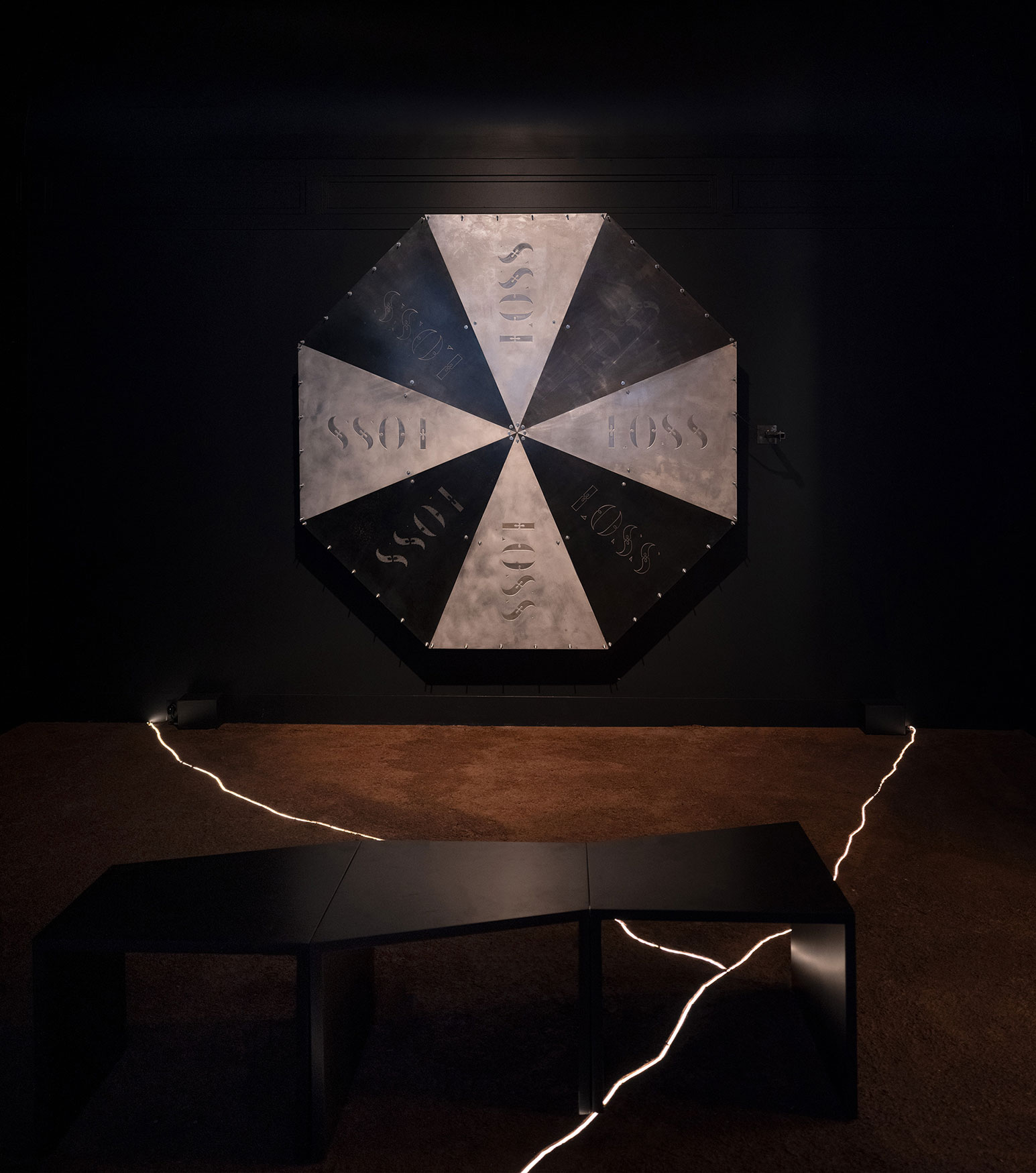
Installation view of Kearra Amaya Gopee, marginalia (2026), in If the word we, 59th Carnegie International, Carnegie Museum of Art, Pittsburgh (May 2, 2026–January 3, 2027); photo: Zachary Riggleman / © Carnegie Museum of Art, Pittsburgh
KAG: I’m always working with metal, largely because of its ability to disintegrate when exposed to water or some other type of material. It functions as a conduit for things that are more elemental, and it’s beholden to them in terms of form. That’s where I start thinking very literally about structure and what is not being structured within the film. How can I create an architecture for holding what cannot be said or cannot be known immediately? I love setting up an architecture and setting terms for people. I establish a starting point for your interaction — several entry points that are possible. I am trying to determine order in a world that has no order… with logics that make sense to me fundamentally. I develop vernaculars for other people to play with as they navigate this architecture, which can be generative for them to adopt for a time as they come into their own language. Any order is temporary. After that, anything can happen; you come to your own conclusions.
GM: You’ve offered this quote from the theorist Kara Keeling, who speaks to the use of poetry and affect to escape the perils of narrative: “At the same time, it points toward the ways that whatever escapes recognition, whatever escapes meaning and valuation, exists as an impossible possibility within our shared reality… and therefore threatens to unsettle, if not destroy, the common sense on which that reality relies for its coherence.”2 Your work addresses the experience of unsettling, even as we are also talking about architecture, structure, and containers. What does this quote mean for you?
KAG: For me, it’s also connected to how Dionne Brand thinks about narrative, as something we necessarily have to escape. My work is meant to unsettle how we think about time, about history, about anti-Blackness overall. Thinking about how to shake up the sediment at the bottom of the river and bring that to the fore. It’s literally unsettling.
GM: It might be my own cynicism, but I always find humor in your work.
KAG: Caribbean people always look at my work and laugh, because that’s the way we communicate with each other. If you don’t laugh, you’ll cry. That’s fundamental for me. The things that happen in the Caribbean really do beget a cynical sense of humor. You can’t take everything happening there so seriously. Many times, when you and I are together, we laugh about something and other people don’t get it. If you don’t get the context, it wasn’t for you.
This is so site-specific and speech-specific in terms of rhythm and syntax; not everyone is going to get it. I’m very much aware that I’m making work in America, but that don’t mean I’m making work for Americans or people in the West. When it comes to humor, you have to be okay with being left out because, well, foreign policy leaves us out all time!
Join us on November 3, 2026, at 5:30 pm in the Carnegie Museum of Art Theater to hear more from Kearra Amaya Gopee. Full details + registration link here.
1. Gloria Wekker, The Politics of Passion: Women’s Sexual Culture in the Afro-Surinamese Diaspora (Columbia University Press, 2006). Mati work refers to “an old practice among Afro-Surinamese work-ing-class women in which marriage is rejected in favor of male and female sexual partners.” Publisher’s description, https://cup.columbia.edu/book/ the-politics-of-passion/9780231131629/.
2. Kara Keeling, Queer Times, Black Futures (New York University Press, 2019), 83.
Portrait by Elliott Jerome Brown Jr.