
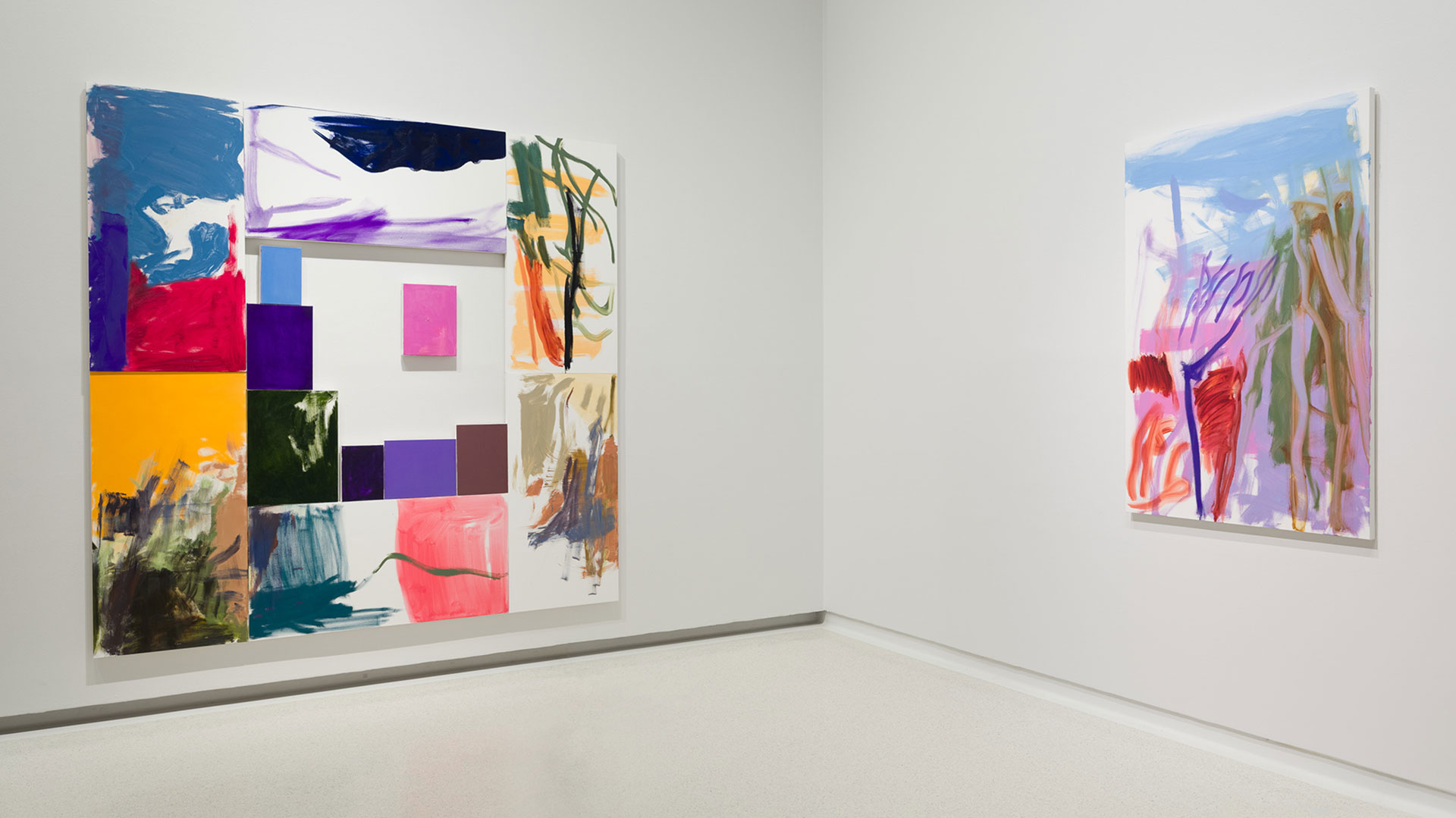
Before RJ Messineo’s visiting artist lecture on October 20, 2026, revisit this conversation between Messineo and artist Nicole Eisenman originally published in the book accompanying If the word we: 59th Carnegie International.
June 13, 2025
Nicole Eisenman: Let’s start with the original lie of painting, which is that you’re re-creating nature.
RJ Messineo: Yeah, and other stories of what we are, how we should be. Often enough painting has been in the service of power, making claims as to the natural order.
NE: Whether you’re doing figuration or abstraction, you have a story in mind. The story is about how you move in real space and how you move in painting space. Some of your paintings give the feeling that you’re holding a brush and strolling across the canvas, this kind of informal movement. There are certain movements or gestures that really imitate or relate to our regular lives, not this weird bubble of studio life.
RJM: Right. Storytelling is a practice. And even when nothing is depicted, there is always the story of how the painting gets made. I painted houses, for example. And it’s like when you’re up on the ladder reaching from as far left to as far right as you can and then you drop down and you repeat that gesture underneath. Reach and repetition are important ideas to me. A lot of the work does rely on this different kind of empty space that a gessoed canvas is. A starting-point space that is also already something quite historical. I realized that with my process, I’ll have a vision of the format at the beginning, but so much of it is about intuition and approaching a structure.
NE: You recently made a move in your work that I thought was really extraordinary, where there was a hole in the painting, or in the canvas, rather, and you could see the gallery wall through it. There’s a sculptural quality to your paintings, but they still remain in painting space. The difference between painting and sculpture, of course, is that you see painting all at once, and you don’t see sculpture all at once. When you’re looking at a sculpture, you’re in one spot and this is the present, and then you move and now that was the past and this is the present, and then you move again and it’s the future. And with painting, you get that special gift of being present in its singular time. But when you start working really big as a painter, eventually you cross over into sculpture space, where you can’t see the whole thing from a single standpoint.
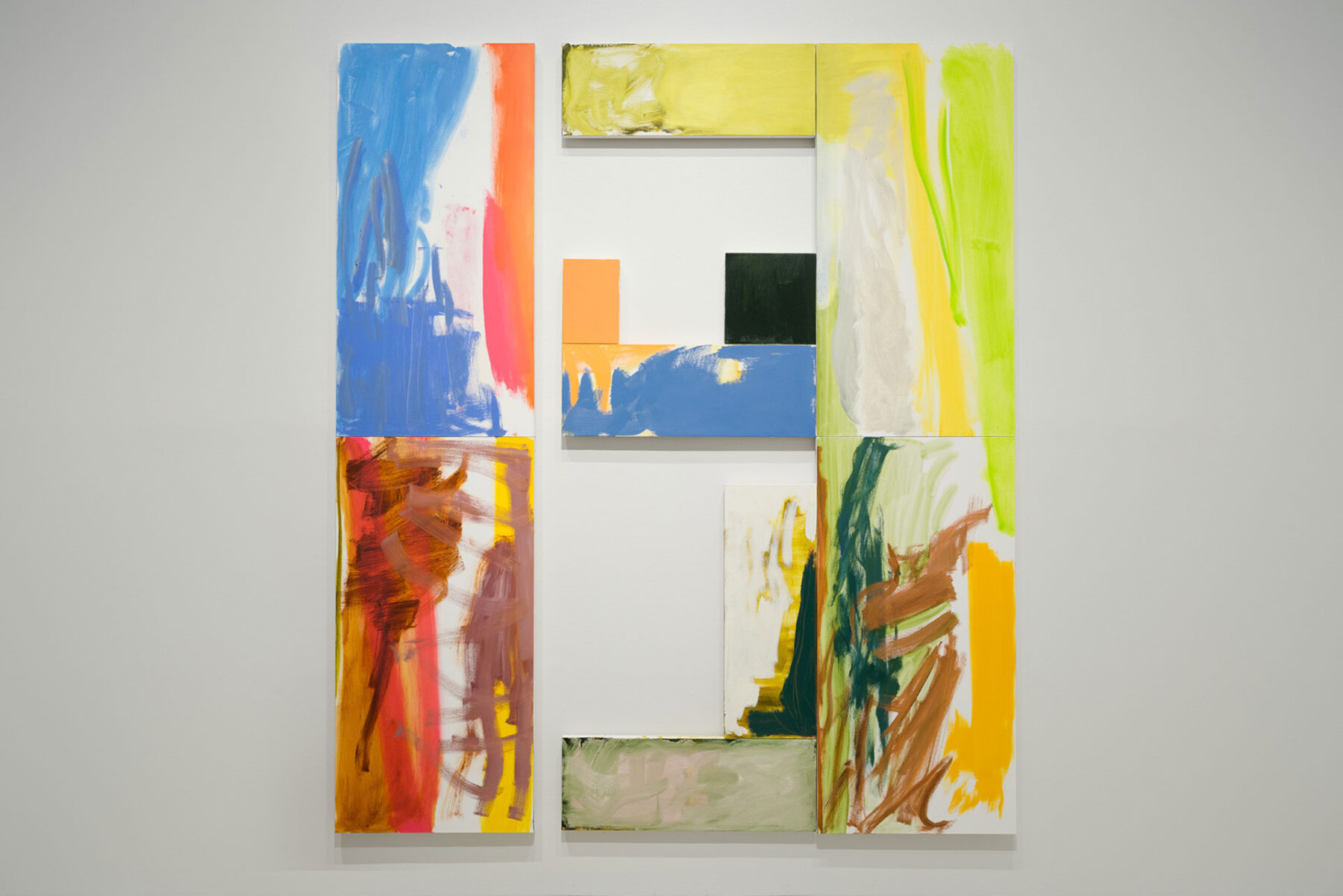
RJ Messineo, Congregation, 2026, oil on canvas, 112 × 92 × 2 3/8 in. (284.5 × 233.7 × 6 cm); Courtesy of the artist and CANADA, New York; commissioned by Carnegie Museum of Art for the 59th Carnegie International; photo: Zachary Riggleman / © Carnegie Museum of Art, Pittsburg
RJM: It’s a scale thing, where you have one impression of a whole, but how does it become that? You step up and that bigger impression is lost.
NE: In order to understand it, you have to do this kind of back-and-forth thing, this two-step dance I often find myself doing with painting. First you approach to understand what the upper right-hand side is doing. Then you can step back and have the memory of it as you look at the rest. Then you come up here and see the upper left…
RJM: I like working large for this experience you describe. A teacher is Joan Mitchell, especially her late 1970s work. There’s this moving across in columns of activity. A field has been built up where there’s all this color relationship that’s so specific and happening and changing — you really get the sense of time.
NE: Time progressing. I’ve heard you talk about interrupting yourself. Maybe that’s another way not to take it all in one go. It’s a kind of disruption.
RJM: It’s a disruption, and it makes your experience more fragmented in the making. And that leads to different kinds of painting.
NE: Because you’re collaborating with different versions of yourself over time. You’ve said that it takes you a long time to understand what you’ve done.
RJM: When I made my first stretched canvas, I immediately covered it with a thin, wooden board. These additions are not about negating the painting plane; it’s more of an extender. It has to do with time and scale. It’s that simultaneity, where the little thing and the big thing are happening at the same time, but they require a whole different kind of receivership. It’s not split, but it’s this ability to—
NE: Hold it all. Your body and the world, that kind of thing?
RJM: Yeah. And that endless multiplicity. Paintings slow it all down, and there’s a fixed-ness to what ends up happening, but there’s a way that you can bring that other experience we don’t always realize we’re having. What continues to be interesting about painting is that you’re forced to deal with the problems of fixedness, because… I don’t know exactly how to say it, but it’s in our politics too. When you’re in the painting, dealing with those problems in your studio, you’re already dealing with them—
NE: —in life. There’s a leap of faith you have to make in order to invest all this time in the possibilities of the two-dimensional plane. Since painting stopped carrying the burden of representation, the studio became an arena for experience and exploration. Paintings tell you a lot about how they re made, but not a lot about why.
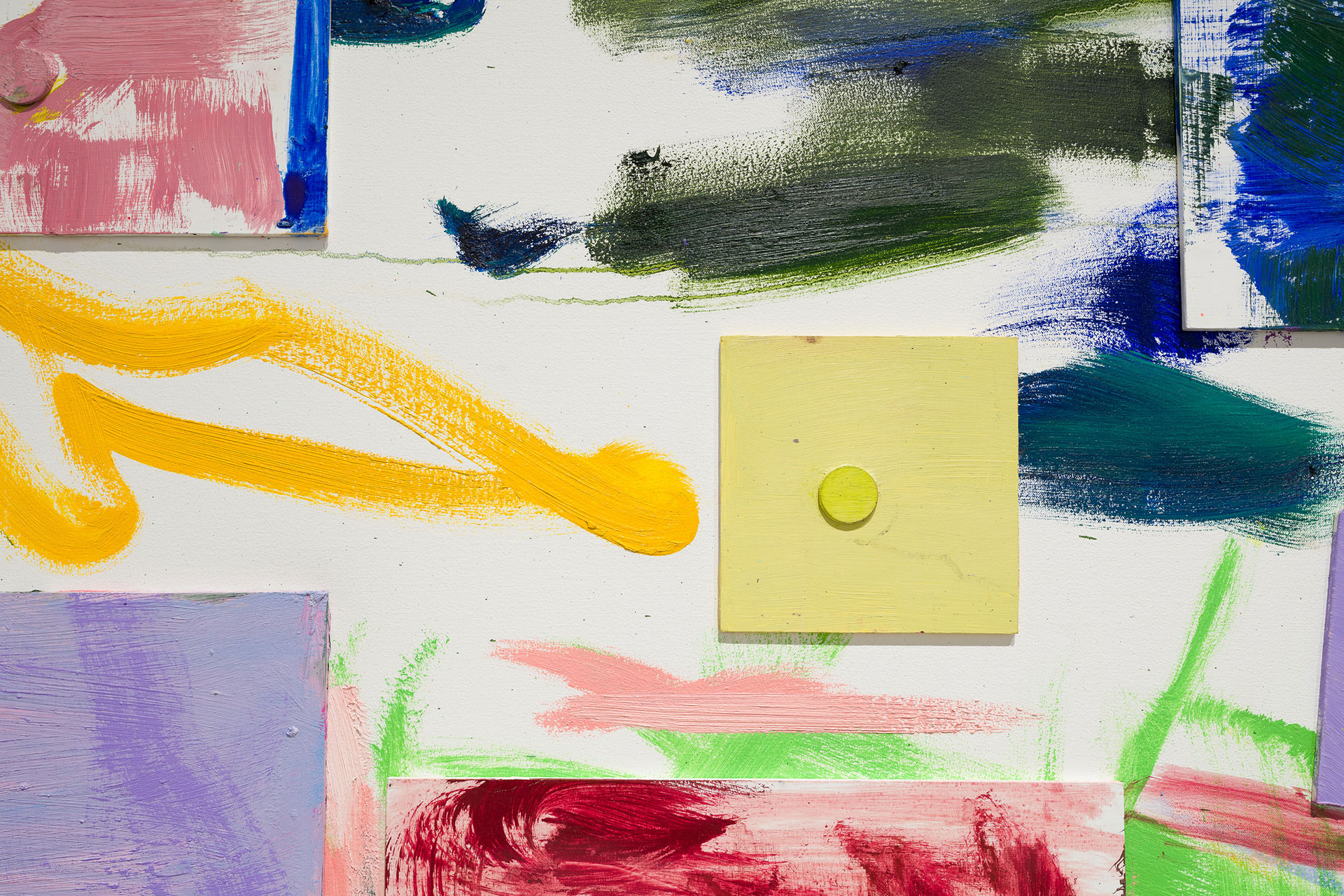
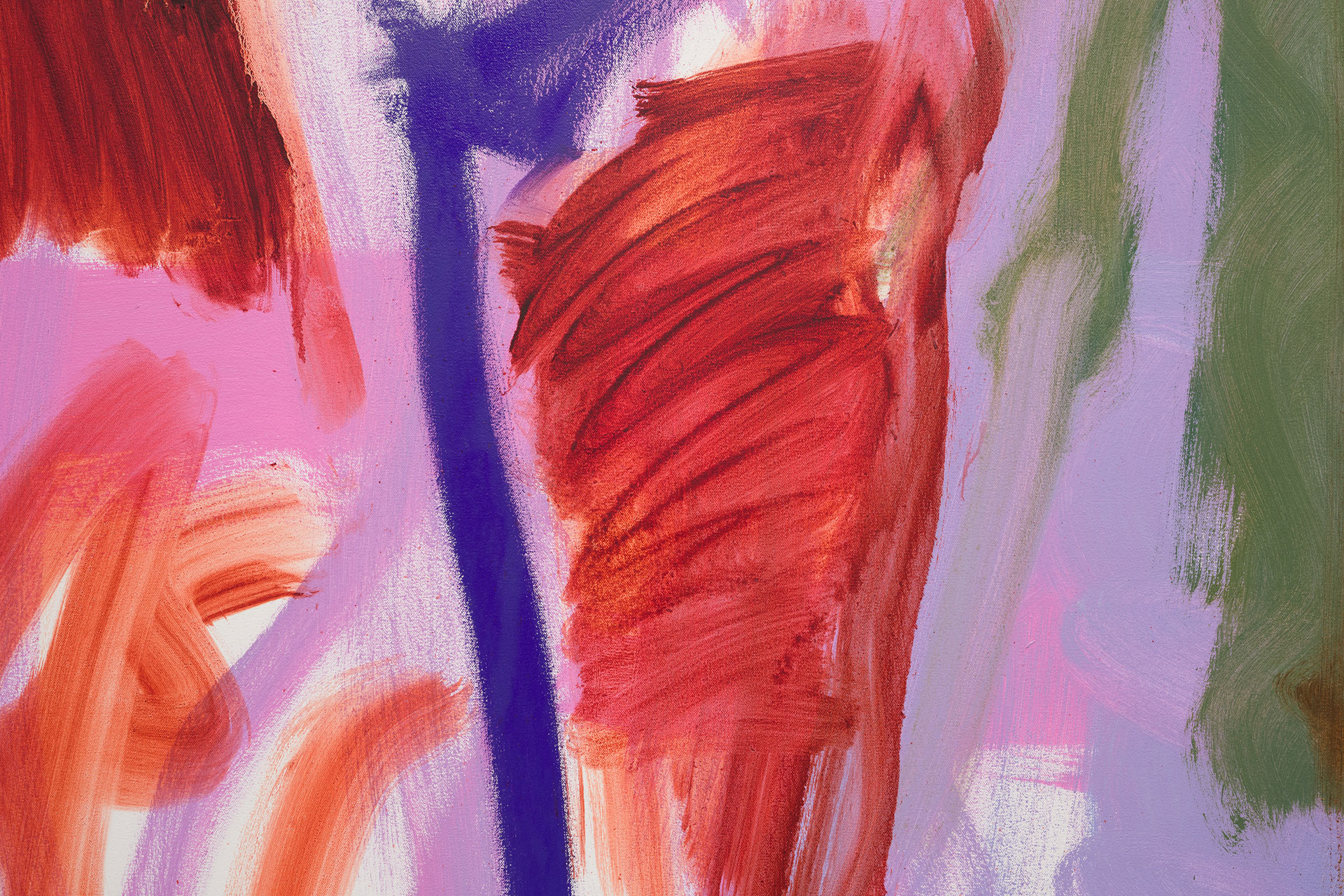
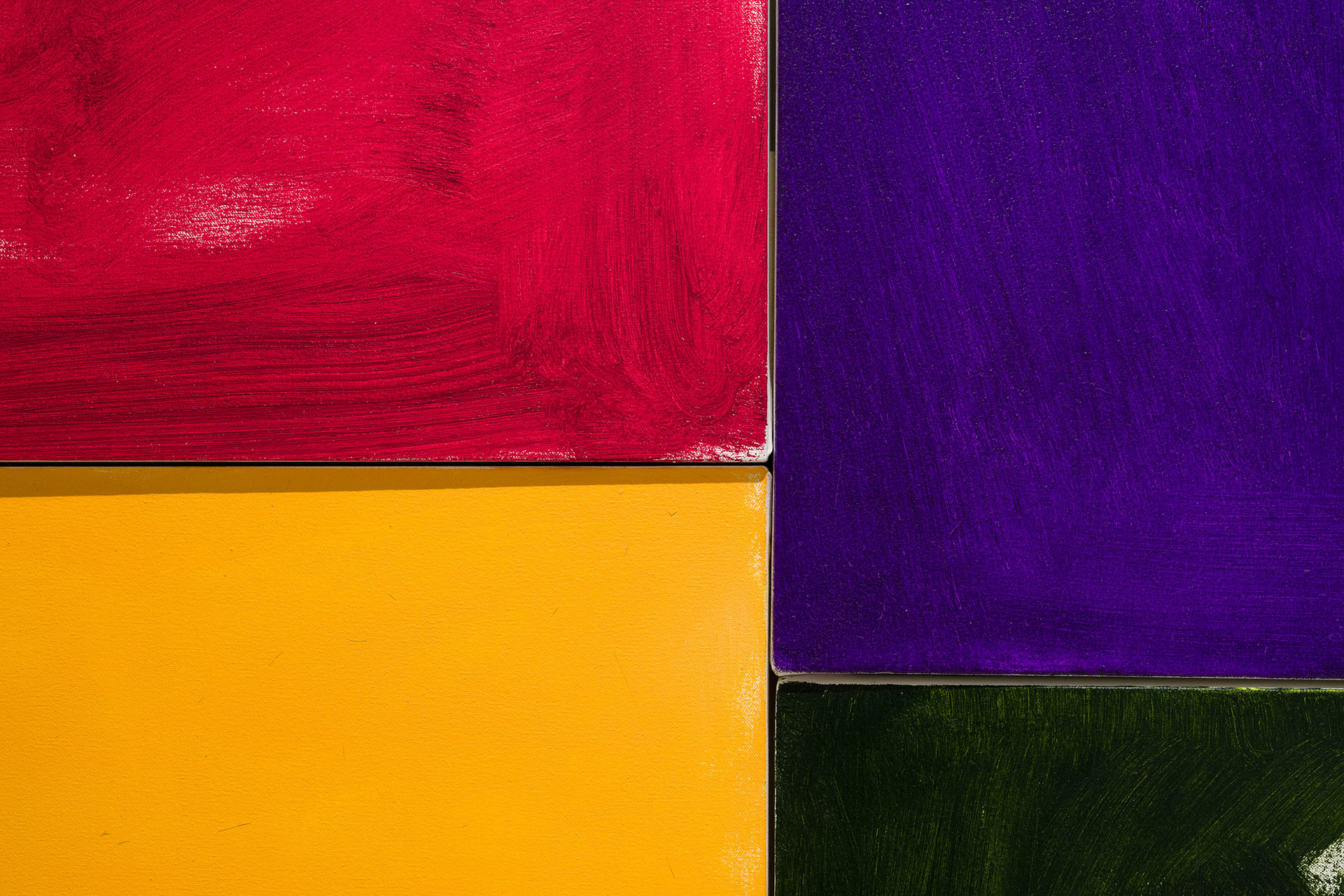
RJ Messineo, Window and Branches (detail), 2026, oil on canvas, 48 × 72 × 1 5/8 in. (121.9 × 182.9 × 4.1 cm); Field Recording (detail), 2026, oil on canvas, 80 × 120 × 1 15/16 in. (203.2 × 304.8 × 4.9 cm); Collection (detail), 2026, oil on canvas, 112 × 112 × 2 3/8 in. (284.5 × 284.5 × 6 cm); Courtesy of the artist and CANADA, New York; commissioned by Carnegie Museum of Art for the 59th Carnegie International; photo: Zachary Riggleman / © Carnegie Museum of Art, Pittsburgh
RJM: It is funny to be making paintings in 2025. When I saw you at my recent show, I asked, “What does it feel like to be in your studio making a painting right now?”
NE: Right. New world orders are emerging. How did we answer that question?
RJM: I think we talked about shame.
NE: Good for us.
RJM: I remember someone saying, “You’re so filled with self-doubt.” And I was like, “Oh, no, let’s be clear. I doubt you just as much. It’s not just myself.” The knowing that you don’t have the capacity to understand is important. I’m reading about plants communicating with each other. We don’t have the organs to perceive that communication or receive it. It’s not meant for us, but that doesn’t mean it doesn’t exist. It is happening. And doubt leaves space for the possibility that I might not even have the apparatus to fundamentally understand. There’s a desire to see things as coming from a certain subjectivity, so that we can read it in this particular way. People get fit into certain historical narratives or understandings, but nothing’s actually fully contained. It’s a way to understand, but it’s not the whole picture. I wonder, for example, how have you navigated, not the question of how the work is queer, but the idea that you’re this thing called queer?
NE: I took the trouble to settle a lot of my identity questions early in life, so I don’t have to give it a ton of consideration now. I’ve occasionally felt pressure to make a correlation between my gender identity and my work, along the lines of: “You’re queer, and your work has this unfixed nature, thus it’s also queer.” Who knows, maybe. There are certain inflection points in art history where an artist’s subjectivity takes on objective historical value. For instance, it matters a lot that Artemisia Gentileschi was able to paint in the early seventeenth century.
RJM: Context is important, and it stretches in every direction. Similarly, identities change over time, like is “woman” even the same category then versus now? We are related. For me, and maybe this has to do with being queer, I’m interested in the idea that it’s all already there. It’s maybe a matter of how we encounter it in the massive archive that never happened. And maybe part of the queer thing is about wanting to build lineages. We’re connected in all these ways!
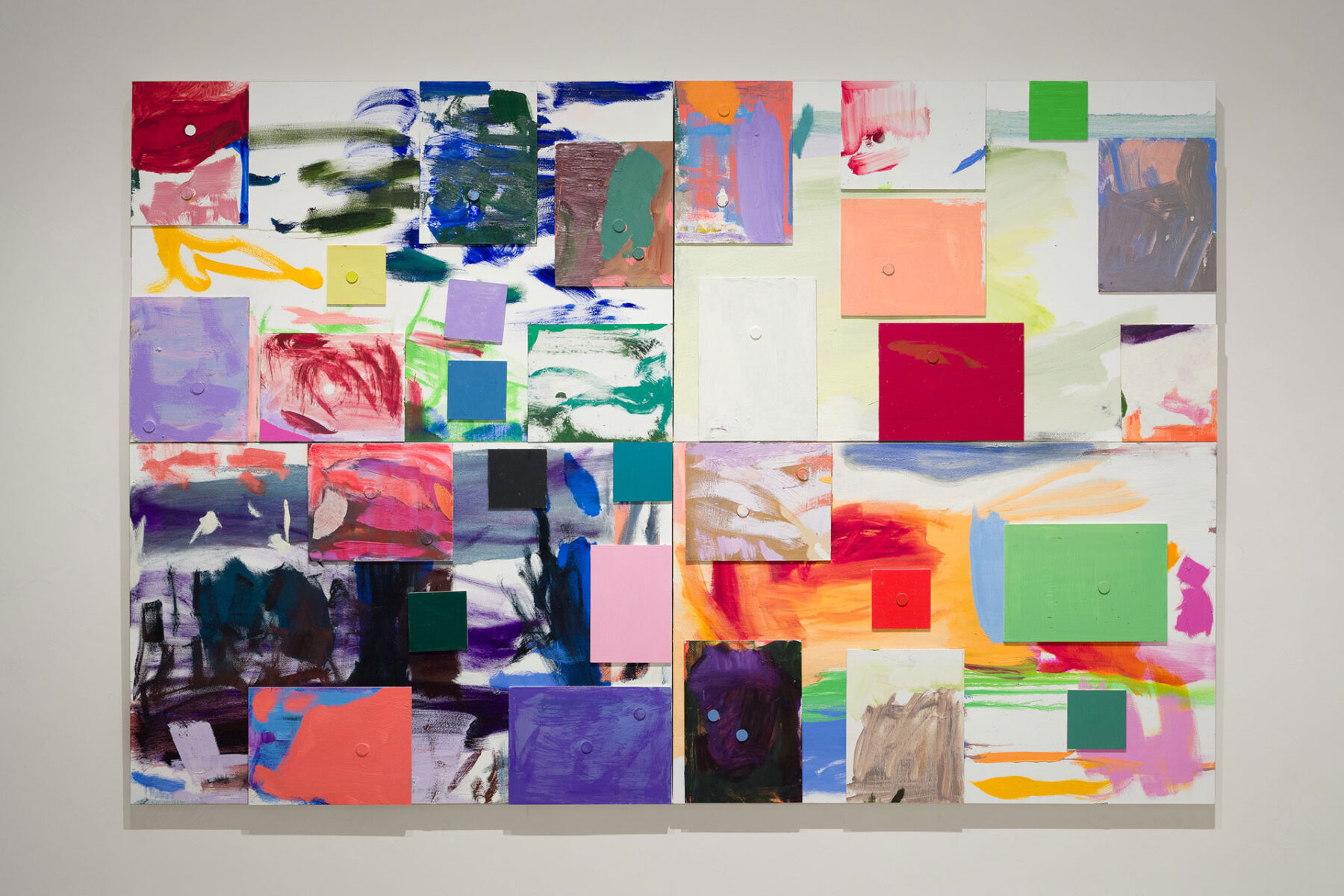
RJ Messineo, Field Recording, 2026, oil on canvas, 80 × 120 × 1 15/16 in. (203.2 × 304.8 × 4.9 cm); Courtesy of the artist and CANADA, New York; commissioned by Carnegie Museum of Art for the 59th Carnegie International; photo: Zachary Riggleman / © Carnegie Museum of Art, Pittsburgh
NE: It could be that we are making the paintings that need to be made in order to finish the canons that were begun long ago. Ideas were put into motion, and we continue expanding out from these big bangs in art history.
RJM: Sometimes I make moves and it’s like, “Okay, maybe that’s muscle memory.” You don’t even have the thought; you have the picture for a moment, and then you grab it. Sometimes I don’t know where the information comes from. It’s like, “Okay, you’re a receiver.” Often in the studio, the painting just sits there, and then you change until you can be in a position to receive it. To see it and to get it.
NE: The artist is a radio receiver, homing in on these subtle signals from god knows where, and the receiver is simultaneously a transmitter. Painting feels intuitive, but it’s just a series of infinitesimally small decisions. I have this feeling that we are all making something together, like a bunch of dung beetles all pushing the big dung ball of culture forward together.
RJM: I have felt that in the process of making something — in the specificity of the time when it’s being made, you get to feel like you’re alongside things that happened before and around you and that you don’t know. You get to feel like you’re working with those things or sharing in them. I want to be beside these things, to be alongside them.
NE: And that word beside also implies: besides that, there’s this.
RJM: Yes! There’s a thing, and then there’s the thing outside of the thing, and then there’s the picture of the thing, the understanding of the thing, the experience of the thing.
NE: I love the idea of this field where whatever you need exists already, and you’re trying to find what’s already there. You have to dig it up, or dig it out.
RJM: The great field of everything.
Join us on October 20, 2026, at 5:30 pm in Kresge Theatre to hear more from RJ Messineo. Full details + registration link here.
Top image: Installation view of If the word we, 59th Carnegie International, Carnegie Museum of Art, Pittsburgh (May 2, 2026–January 3, 2027), featuring works by RJ Messineo; photo: Zachary Riggleman / © Carnegie Museum of Art, Pittsburgh